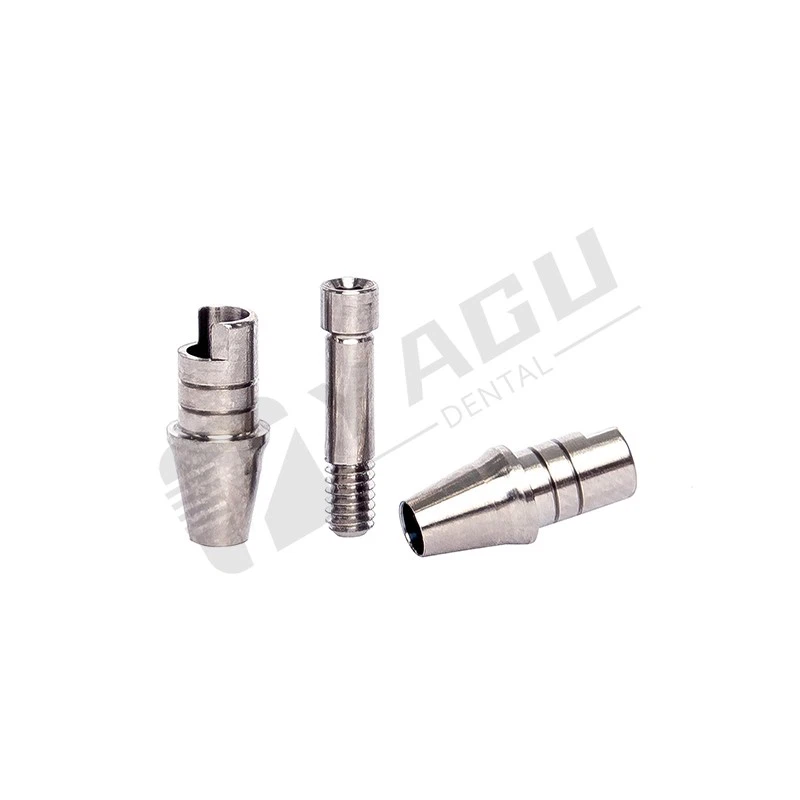
Hey there! As a supplier of Nobel Ti Base, I'm super excited to dive into the topic of surface treatments available for these bad boys. Nobel Ti Base is known for its high - quality and reliability in the dental implant field, and the surface treatments play a huge role in enhancing its performance.

Let's start with one of the most common surface treatments: Sandblasting and Acid - Etching (SLA). This method involves blasting the surface of the Nobel Ti Base with tiny particles to create a rough texture, followed by an acid - etching process. The result is a surface with micro - and macro - roughness. The micro - roughness provides more surface area for the bone cells to attach to, while the macro - roughness helps in the initial mechanical interlocking with the bone. Studies have shown that implants with SLA surface treatments have a faster and stronger bone integration compared to smooth - surfaced implants. This means that patients can expect a quicker recovery time and a more stable implant in the long run. For instance, when a patient gets a dental implant with an SLA - treated Nobel Ti Base, the bone starts to grow around the implant more rapidly, reducing the risk of implant failure.

Another popular surface treatment is Plasma - Sprayed Hydroxyapatite (PSHA). Hydroxyapatite is a mineral that is very similar to the mineral component of human bone. By using a plasma - spraying technique, a layer of hydroxyapatite is applied to the surface of the Nobel Ti Base. This layer acts as a sort of "welcome mat" for the bone cells. It attracts the bone - forming cells, called osteoblasts, and encourages them to adhere and grow on the implant surface. The PSHA treatment can significantly improve the biocompatibility of the Nobel Ti Base. Biocompatibility is crucial because it determines how well the body accepts the implant without triggering an immune response. With a PSHA - treated implant, the chances of the body rejecting the implant are much lower.
Anodization is also an interesting surface treatment option. In this process, the Nobel Ti Base is immersed in an electrolyte solution and an electric current is passed through it. This causes a controlled oxidation of the titanium surface, creating a thin, protective oxide layer. The anodized layer can have different properties depending on the parameters of the anodization process. For example, it can be made more porous, which is beneficial for cell adhesion and nutrient transport. It can also be colored, which is useful for identifying different types of implants or for aesthetic purposes. Some dentists prefer anodized Nobel Ti Base because it gives them more flexibility in terms of customization and performance.
Now, let's talk about how these surface treatments compare to other products in the market. Take the Megagen Ti Base for example. While Megagen also offers a range of surface treatments, the Nobel Ti Base has a long - standing reputation for its research and development in this area. The surface treatments on Nobel Ti Base are backed by years of scientific studies and clinical trials, which gives dentists and patients more confidence in its performance. Similarly, the Dentium Lab Model Analog is another product in the dental implant parts market. However, the focus of the Dentium Lab Model Analog is more on the accuracy of the laboratory model, while the Nobel Ti Base with its advanced surface treatments is centered around promoting better bone integration. And when we look at the Straumann Temporary Abutment, it serves a different purpose in the dental implant process. The Straumann Temporary Abutment is mainly used during the healing phase, while the Nobel Ti Base is a crucial part of the long - term implant structure, and its surface treatments are designed to ensure long - term stability.
The choice of surface treatment for the Nobel Ti Base also depends on the patient's specific condition. For patients with good bone quality, an SLA - treated Nobel Ti Base might be a great choice as it can provide a quick and strong bond with the bone. On the other hand, for patients with poor bone quality, a PSHA - treated implant could be more suitable because the hydroxyapatite layer can help stimulate bone growth in less - than - ideal conditions.
In addition to the well - known surface treatments, there are also some emerging technologies in this field. For example, some researchers are exploring the use of bioactive coatings on the Nobel Ti Base. These coatings can release certain growth factors or antibiotics to further enhance the implant's performance. Growth factors can stimulate the growth of bone cells, while antibiotics can prevent infections around the implant. Although these technologies are still in the experimental stage, they show a lot of promise for the future of dental implants.
As a supplier of Nobel Ti Base, I understand the importance of providing high - quality products with the best surface treatments. We work closely with dental professionals to ensure that they get the right type of Nobel Ti Base with the most appropriate surface treatment for their patients. Whether it's for a single - tooth implant or a full - mouth restoration, we have the expertise to help you make the best choice.

If you're a dentist or a dental laboratory looking for reliable Nobel Ti Base products, I encourage you to reach out to us for a detailed discussion. We can provide you with samples, technical specifications, and pricing information. Let's work together to give your patients the best dental implant experience possible.
References
- Albrektsson T, Wennerberg A. An update of the osseointegration concept. J Prosthet Dent. 2004;91(5):416 - 419.
- Buser D, Martin W, Belser UC. Optimizing bone - to - implant contact. Clin Oral Implants Res. 2004;15(6):675 - 684.
- Lemons JE. An overview of the biocompatibility of titanium and its alloys. J Biomed Mater Res A. 2008;86(3):481 - 488.