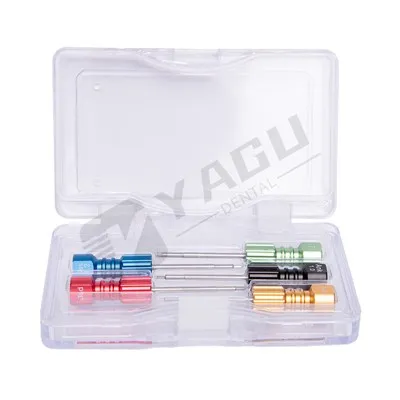
Hey there! As a supplier of Straight Abutments, I've been getting a lot of questions lately about what the standards for the strength of a straight abutment are. So, I thought I'd take a few minutes to break it down for you.
First off, let's talk about what a straight abutment is. A straight abutment is a component used in dental implants. It's basically a connector that attaches the implant fixture (which is placed in the jawbone) to the dental prosthesis (like a crown or a bridge). The straight abutment plays a crucial role in the overall functionality and stability of the dental implant system.
Now, when it comes to the strength of a straight abutment, there are several key standards and factors to consider.
Material Quality
The material used to make the straight abutment is one of the most important factors. Most straight abutments are made from titanium or titanium alloys. Titanium is a great choice because it's biocompatible, which means it's well - tolerated by the human body and doesn't cause any adverse reactions. It also has excellent corrosion resistance, which is crucial since it will be in a wet and acidic environment in the mouth.
High - quality titanium alloys can offer even better strength properties. For example, some alloys are designed to have a higher yield strength and ultimate tensile strength. The yield strength is the amount of stress a material can withstand before it starts to deform permanently, while the ultimate tensile strength is the maximum stress it can withstand before breaking.


We ensure that the straight abutments we supply are made from top - notch titanium alloys. This gives them the durability and strength needed to handle the forces exerted during chewing and biting. You can check out our Straight Abutment product page to learn more about the materials we use.
Design and Geometry
The design of the straight abutment also affects its strength. A well - designed abutment will have a proper shape and size to distribute the forces evenly. For instance, the diameter of the abutment at the connection with the implant fixture is important. A larger diameter can provide more surface area for load transfer, which reduces the stress concentration at the interface.
The height of the abutment also matters. If it's too tall, it can act like a lever, increasing the bending forces on the implant - abutment connection. On the other hand, if it's too short, it may not provide enough support for the dental prosthesis. Our engineers spend a lot of time optimizing the design of our straight abutments to ensure they have the right balance of strength and functionality.
Surface Finish
The surface finish of the straight abutment can impact its strength in a couple of ways. A smooth surface finish can reduce the risk of stress concentrations. Rough surfaces can act as stress raisers, where the stress is concentrated in small areas, making the abutment more likely to fail.
In addition, a proper surface finish can also improve the fit between the abutment and the implant fixture. A tight and precise fit ensures that the forces are transferred efficiently between the two components. We use advanced manufacturing techniques to achieve a high - quality surface finish on our straight abutments.
Connection Type
The type of connection between the straight abutment and the implant fixture is another important factor. There are different types of connections, such as external hexagon, internal hexagon, and conical connections.
External hexagon connections are relatively simple and have been used for a long time. However, they may be more prone to micro - movements, which can lead to loosening over time. Internal hexagon connections offer better stability and can reduce the risk of micro - leakage. Conical connections are known for their excellent self - centering ability and can provide a very tight and strong connection.
We offer straight abutments with different connection types to meet the specific needs of our customers. You can choose the one that best suits your implant system and patient requirements.
Testing and Certification
To ensure that our straight abutments meet the highest standards of strength, we subject them to rigorous testing. We use advanced testing equipment to simulate the forces that the abutments will experience in the mouth. This includes cyclic loading tests, which mimic the repeated chewing and biting forces over time.
We also follow international standards and obtain relevant certifications. These certifications are a testament to the quality and strength of our products. When you choose our straight abutments, you can be confident that they have been thoroughly tested and meet all the necessary safety and performance requirements.
Comparison with Other Abutments
It's also interesting to compare straight abutments with other types of abutments, like Osstem Angled Abutment and Straumann Multi Unit Abutment.
Osstem angled abutments are designed for cases where the implant is not placed in a perfectly straight position. They can provide an angled connection to the dental prosthesis, which can be useful in certain anatomical situations. However, the angled design may introduce additional bending forces, so they need to be carefully designed and tested for strength.
Straumann multi - unit abutments are used when multiple implants are connected to a single dental prosthesis. They need to be strong enough to distribute the loads evenly across the implant system. Our straight abutments, on the other hand, are a great choice for simple, straight - forward implant cases where a direct connection between the implant and the prosthesis is required.
Why Choose Our Straight Abutments
As a supplier, we're committed to providing high - quality straight abutments. We use the best materials, advanced manufacturing techniques, and strict quality control processes. Our products are designed to meet the highest standards of strength and durability.
We also offer excellent customer service. If you have any questions about our straight abutments or need help choosing the right product for your patients, our team of experts is here to assist you. Whether you're a dentist, a dental laboratory, or a distributor, we can work with you to meet your specific needs.
Contact Us for Purchase and洽谈
If you're interested in purchasing our straight abutments or want to learn more about our products, we'd love to hear from you. We can provide you with detailed product information, pricing, and samples if needed. Don't hesitate to reach out to us to start a discussion about your requirements. We're looking forward to working with you and helping you provide the best dental solutions for your patients.
References
- "Dental Implant Prosthetics: A Comprehensive Approach" by various authors, which provides in - depth information on dental implant components and their strength requirements.
- Research papers on titanium alloys and their applications in dental implants, which discuss the material properties and performance of different alloys.
- International standards for dental implants and abutments, such as ISO standards, which define the testing and performance requirements for these products.