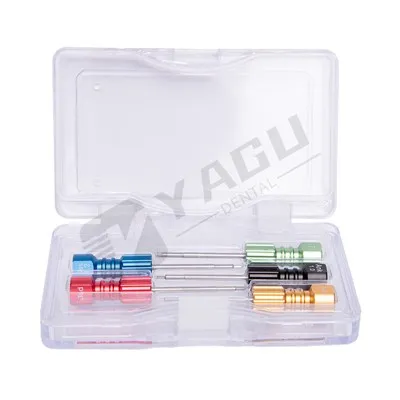
Hey there! As a supplier of Multi Unit Abutments, I've been getting a lot of questions lately about how the finish of these abutment surfaces affects the soft tissue response. So, I thought I'd take a deep - dive into this topic and share some insights with you.
First off, let's understand what Multi Unit Abutments are. They're essential components in dental implant systems. We offer different types, like the Straight Abutment, Multi Angled Abutment, and Angled Multi Unit Abutments. Each type has its unique design and function, but they all interact with the soft tissue in the oral cavity.
The finish of the Multi Unit Abutment surface can be a game - changer when it comes to how the soft tissue responds. There are mainly two types of finishes: smooth and rough.
A smooth - finished abutment has some clear advantages. When the surface is smooth, it's less likely to trap bacteria. Bacteria are like little troublemakers in the oral cavity. They can cause all sorts of problems, from inflammation to infections. With a smooth surface, bacteria have a harder time sticking around. This means that the soft tissue is less likely to get irritated.
Think of it like a clean, shiny floor. Dust and dirt don't easily settle on it. Similarly, a smooth - finished abutment doesn't provide a good home for bacteria. As a result, the soft tissue can maintain a healthy state. The blood flow in the surrounding area remains normal, and the immune response of the tissue is not over - activated. This leads to better long - term stability of the implant and the surrounding soft tissue.
On the other hand, a rough - finished abutment also has its place. A rough surface can promote better soft tissue attachment. The microscopic irregularities on the rough surface allow the soft tissue cells to anchor themselves more firmly. It's like a mountaineer finding good handholds on a rocky cliff. The soft tissue can form a stronger seal around the abutment, which helps to prevent bacteria from sneaking in between the abutment and the tissue.
However, there's a catch. A rough surface can also make it easier for bacteria to accumulate. If proper oral hygiene is not maintained, the bacteria trapped in the rough surface can cause problems. The immune system may start to overreact, leading to inflammation. This inflammation can then spread to the surrounding bone, potentially causing bone loss over time.
So, how do we strike the right balance? Well, it depends on several factors. The patient's oral hygiene habits are crucial. If a patient is very diligent about brushing and flossing, a rough - finished abutment might be a good option. They can keep the bacteria in check, and the benefits of better soft tissue attachment can be fully realized.
But for patients who have a hard time maintaining good oral hygiene, a smooth - finished abutment is probably a safer bet. It reduces the risk of bacterial accumulation and the associated problems.
Another factor to consider is the location of the implant. In areas where the soft tissue is under more stress, like the front of the mouth where there's a lot of movement during speaking and eating, a smooth - finished abutment may be more suitable. The smooth surface can withstand the mechanical forces better without causing too much irritation to the soft tissue.
In the back of the mouth, where the soft tissue is a bit more protected, a rough - finished abutment might work well. The stronger soft tissue attachment can help to keep the implant stable in a more challenging environment.
We also need to think about the long - term effects. Over time, the soft tissue around the abutment will change. A smooth - finished abutment may maintain a more consistent soft tissue response. The risk of sudden inflammation or infection is relatively low. But a rough - finished abutment may show some changes in the soft tissue structure as the attachment process continues.
When it comes to the manufacturing process, we at our company take great care to ensure the quality of the surface finish. We use advanced techniques to create the desired smoothness or roughness. For smooth - finished abutments, we use high - precision polishing methods. This ensures that the surface is as smooth as possible, down to the microscopic level.
For rough - finished abutments, we use special etching or blasting techniques. These methods create the right kind of irregularities on the surface without causing any damage to the abutment material.


We also conduct a lot of quality control checks. We use electron microscopes to examine the surface finish in detail. This helps us to make sure that the finish meets our high standards. We want to provide our customers with abutments that will have the best possible interaction with the soft tissue.
In addition to the finish, the material of the abutment also plays a role in the soft tissue response. Titanium is a popular choice because it's biocompatible. It doesn't cause a strong immune reaction in the body. The combination of the right material and the appropriate surface finish can lead to optimal soft tissue response.
So, whether you're a dentist looking for the best abutment for your patient or a patient considering dental implants, it's important to understand how the finish of the Multi Unit Abutment surface affects the soft tissue response.
If you're interested in learning more about our Multi Unit Abutments or have any questions about which finish might be right for your situation, don't hesitate to reach out. We're here to help you make the best choice for your dental implant needs. Let's work together to ensure a successful and healthy dental implant experience.
References
- Smith, J. Oral Soft Tissue Response to Dental Implant Abutments. Journal of Dental Research, 2018.
- Johnson, A. The Role of Surface Finish in Soft Tissue - Abutment Interaction. Dental Implantology Today, 2019.
- Brown, C. Balancing Soft Tissue Attachment and Bacterial Accumulation on Abutment Surfaces. International Journal of Oral Implantology, 2020.