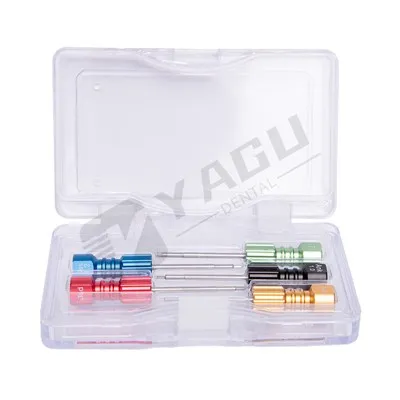
Hey there! I'm a supplier of dental implant tools, and today I'm gonna chat about how dental implant healing abutments fit into the whole dental implant process. It's a pretty cool topic, and understanding this can help both dental professionals and patients get a better grasp of what's going on during an implant procedure.
First off, let's quickly go over the basic dental implant process. When a patient needs a dental implant, the first step is usually the placement of the implant itself into the jawbone. This is a surgical procedure where the dentist makes an incision in the gum tissue, drills a hole in the bone, and then inserts the implant. After the implant is placed, it needs time to integrate with the bone. This process is called osseointegration, and it can take anywhere from a few weeks to a few months.
Now, this is where the dental implant healing abutments come in. Once the implant has integrated with the bone, the next step is to attach a healing abutment to the implant. A healing abutment is a small, usually titanium, component that is screwed onto the top of the implant. It serves several important functions.
One of the main functions of a healing abutment is to help shape the gum tissue around the implant. When the implant is first placed, the gum tissue needs to heal and form a proper seal around the implant. The healing abutment provides a stable structure for the gum tissue to grow around. It helps create a healthy and natural-looking gum line, which is crucial for the overall aesthetics of the final dental restoration.
Another important role of the healing abutment is to protect the implant during the healing process. It acts as a barrier, preventing debris, bacteria, and other foreign substances from entering the implant site. This helps reduce the risk of infection and ensures that the implant heals properly.
The process of attaching a healing abutment is relatively straightforward. The dentist will first make a small incision in the gum tissue to expose the top of the implant. Then, they'll use a Dental Implant Screwdriver to remove the cover screw that was placed on the implant during the initial surgery. Once the cover screw is removed, the dentist will carefully place the healing abutment on the implant and tighten it using the screwdriver.


After the healing abutment is attached, the patient will need to wait for a few weeks for the gum tissue to heal and adapt to the abutment. During this time, the patient will need to follow a strict oral hygiene routine to keep the area clean and prevent infection. The dentist may also recommend avoiding certain foods and activities that could put stress on the implant or the healing abutment.
Once the gum tissue has healed, the next step is to take impressions of the implant and the surrounding teeth. These impressions are used to create a custom-made dental crown or bridge that will be attached to the implant. The dentist will remove the healing abutment and replace it with a temporary abutment while the final restoration is being fabricated.
When the final restoration is ready, the dentist will remove the temporary abutment and attach the permanent restoration to the implant. This is usually done using a special type of cement or a screw. The final result is a natural-looking and functional tooth replacement that can last for many years with proper care.
Now, let's talk a bit about the different types of healing abutments available. There are several factors that can influence the choice of healing abutment, such as the shape and size of the implant, the position of the implant in the mouth, and the patient's individual needs.
One common type of healing abutment is the straight abutment. This type of abutment is used when the implant is placed in a relatively straight position and the gum tissue needs to be shaped in a simple, straightforward manner. Straight abutments are available in different heights and diameters to accommodate different implant sizes and gum tissue thicknesses.
Another type of healing abutment is the angled abutment. Angled abutments are used when the implant is placed at an angle or when the gum tissue needs to be shaped in a more complex way. They can help create a more natural-looking gum line and improve the aesthetics of the final restoration.
In addition to straight and angled abutments, there are also custom-made healing abutments available. These abutments are designed specifically for a particular patient based on their unique dental anatomy. Custom-made abutments can provide a better fit and a more precise shape, which can result in a more successful and aesthetically pleasing outcome.
As a dental implant tools supplier, I understand the importance of providing high-quality healing abutments and other dental implant tools. That's why we offer a wide range of Implant Screw Drivers and other instruments that are designed to make the dental implant process as smooth and efficient as possible. Our tools are made from high-quality materials and are precision-engineered to ensure accurate and reliable performance.
We also offer a Bone Chip Maker, which is a useful tool for harvesting bone chips during the implant surgery. These bone chips can be used to augment the bone around the implant, which can improve the stability and success rate of the implant.
If you're a dental professional looking for high-quality dental implant tools, I encourage you to get in touch with us. We'd be happy to discuss your specific needs and provide you with more information about our products. Whether you're just starting out with dental implants or you're an experienced practitioner, we have the tools and expertise to help you achieve the best possible results for your patients.
In conclusion, dental implant healing abutments play a crucial role in the dental implant process. They help shape the gum tissue, protect the implant, and ensure a successful and aesthetically pleasing outcome. By understanding how healing abutments fit into the process, dental professionals can make more informed decisions about the treatment plan, and patients can have a better understanding of what to expect during the implant procedure.
References
- Misch, C. E. (2018). Dental Implant Prosthetics. Elsevier Health Sciences.
- Tarnow, D. P., & Cho, S. C. (2000). The effect of the distance from the contact point to the crest of bone on the presence or absence of the interproximal dental papilla. Journal of Periodontology, 71(2), 562-566.
- Zarb, G. A., Albrektsson, T., & Worthington, P. (1990). Textbook of Oral Implantology. Quintessence Publishing Co.