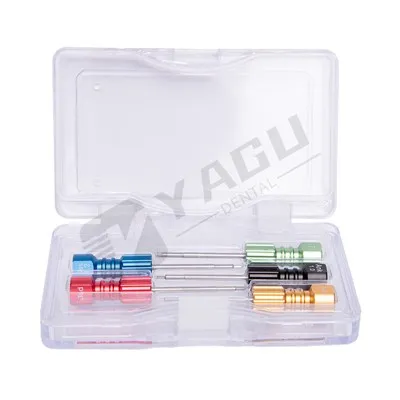
Can castable abutments be customized? This is a question that many dental professionals and patients often ask. As a supplier of Castable Abutments, I'd like to delve into this topic in detail and share some insights based on our experiences and industry knowledge.
Understanding Castable Abutments
Castable abutments are an essential component in dental implant restorations. They serve as the connection between the dental implant fixture in the jawbone and the final dental prosthesis, such as a crown or a bridge. These abutments are typically made of materials that can be cast, like precious metals or metal alloys, which offer good strength, durability, and biocompatibility.
The use of castable abutments allows for a high degree of flexibility in the restoration process. They can be adjusted and customized to fit the unique anatomical and functional requirements of each patient's mouth. This is in contrast to pre - milled abutments, such as the Straumann Pre Milled Abutment and Dentium 14mm Premill Abutment, which come in standard sizes and shapes. While pre - milled abutments are convenient and can be used in many cases, they may not always provide the perfect fit for every patient.
The Customization Process of Castable Abutments
One of the significant advantages of castable abutments is their customizability. The customization process starts with a detailed assessment of the patient's oral condition. This includes taking accurate impressions of the implant site, analyzing the patient's bite, and considering the aesthetic and functional requirements of the final restoration.
Dental technicians use these impressions to create a master model of the patient's mouth. On this model, they can design and fabricate a custom - made castable abutment. The design process involves shaping the abutment to match the contour of the surrounding soft tissues, ensuring proper emergence profile, and providing a stable foundation for the final prosthesis.
The actual casting process is a precise and technical procedure. A wax pattern of the custom - designed abutment is first created on the master model. This wax pattern is then invested in a special casting material and heated to remove the wax. Molten metal is then poured into the resulting mold, taking the shape of the custom - designed abutment. After the metal has cooled and solidified, the abutment is removed from the mold, finished, and polished to achieve the desired surface quality.
Benefits of Customized Castable Abutments
- Improved Fit and Function: Customized castable abutments can be tailored to fit the specific implant and the patient's oral anatomy perfectly. This results in better stability and retention of the final prosthesis, reducing the risk of complications such as loosening or fracture.
- Enhanced Aesthetics: By customizing the emergence profile of the abutment, it is possible to create a more natural - looking transition from the implant to the final restoration. This can significantly improve the overall aesthetic outcome of the dental implant treatment.
- Biocompatibility and Soft Tissue Health: A well - customized abutment can promote better soft tissue integration and health. It can help maintain the proper contour and thickness of the gingival tissue, reducing the risk of gum recession and other soft tissue problems.
- Patient Comfort: A custom - made abutment is more likely to be comfortable for the patient. It can minimize irritation to the surrounding tissues and provide a more natural feel, improving the patient's overall experience with the dental implant restoration.
Factors Affecting Customization
While castable abutments offer great potential for customization, there are several factors that can affect the process and the final outcome.
- Implant Design and Position: The design and position of the dental implant in the jawbone can influence the design of the castable abutment. For example, an implant that is placed at an unfavorable angle may require a more complex abutment design to achieve proper alignment and function.
- Patient's Oral Anatomy: The unique anatomical features of the patient's mouth, such as the shape of the arch, the position of the adjacent teeth, and the thickness of the soft tissues, need to be carefully considered during the customization process.
- Material Selection: The choice of casting material can also impact the customization process. Different metals and alloys have different properties, such as strength, corrosion resistance, and casting shrinkage. These properties need to be taken into account to ensure that the final abutment meets the required standards.
Our Role as a Castable Abutments Supplier
As a supplier of Castable Abutments, we understand the importance of providing high - quality, customizable products. We work closely with dental laboratories and professionals to ensure that they have access to the best materials and technologies for creating custom - made castable abutments.
We offer a wide range of casting materials, including precious metals and metal alloys, to meet the diverse needs of our customers. Our materials are carefully selected for their quality, biocompatibility, and casting properties. We also provide technical support and training to help dental technicians optimize the casting process and achieve the best results.
In addition, we keep up with the latest trends and advancements in the field of dental implantology. We invest in research and development to continuously improve our products and services, ensuring that we can offer the most innovative solutions for customized castable abutments.


Contact Us for Procurement and Consultation
If you are a dental professional or a dental laboratory interested in our Castable Abutments, we would be delighted to hear from you. Whether you need more information about our products, want to discuss customization options, or are ready to place an order, please feel free to reach out to us. We are committed to providing you with the best products and services to meet your specific needs.
References
- Misch, C. E. (2010). Dental Implant Prosthetics. Mosby.
- Tarnow, D. P., et al. (2003). The effect of the abutment - implant connection design on the health of the peri - implant tissues. Journal of Periodontology, 74(11), 1603 - 1609.
- Rosenstiel, S. F., Land, M. F., & Fujimoto, J. (2015). Contemporary Fixed Prosthodontics. Elsevier.