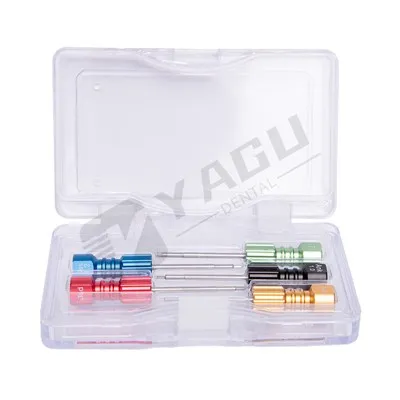
Nobel Temporary Abutments are crucial components in dental implant procedures, serving as a temporary connection between the dental implant and the prosthetic restoration. As a supplier of these essential products, I am often asked about the materials used in their production. In this blog post, I will explore the various materials commonly employed in making Nobel Temporary Abutments, their properties, and how they contribute to the overall success of dental implant treatments.
Titanium and Titanium Alloys
Titanium is one of the most widely used materials for Nobel Temporary Abutments, and for good reason. Titanium is biocompatible, which means it is well - tolerated by the human body. When placed in the oral cavity, it does not trigger significant immune responses, reducing the risk of rejection and inflammation. This biocompatibility is essential for the long - term success of dental implants, as it allows for stable osseointegration (the process by which the implant fuses with the surrounding bone).
Titanium also has excellent corrosion resistance. The oral environment is a challenging one, with exposure to saliva, food, and various chemicals. Titanium forms a thin, protective oxide layer on its surface when exposed to oxygen, which prevents corrosion and ensures the longevity of the abutment.
In addition to pure titanium, titanium alloys are also used. Alloys are created by combining titanium with other elements such as aluminum and vanadium. These alloys offer enhanced mechanical properties compared to pure titanium. They are stronger and more rigid, which is beneficial in withstanding the forces exerted during chewing and biting. For example, in cases where patients have a high bite force or require a more robust restoration, titanium alloy abutments can provide the necessary support.
You can find high - quality titanium - based products like Tibase in our product range, which are designed to meet the demanding requirements of modern dental implant procedures.
Zirconia
Zirconia has gained popularity in recent years as a material for Nobel Temporary Abutments. One of the main advantages of zirconia is its aesthetic appeal. It has a natural tooth - like appearance, making it an ideal choice for patients who are concerned about the visibility of the abutment, especially in the anterior region of the mouth.
Zirconia is also extremely strong and durable. It has high fracture toughness, which means it can resist cracking and breaking under normal chewing forces. This makes it suitable for long - term use, even in areas of the mouth that experience significant stress.
Another benefit of zirconia is its low thermal conductivity. Unlike metal abutments, zirconia does not transfer heat as readily, which can enhance patient comfort. It also has good biocompatibility, similar to titanium, and is less likely to cause allergic reactions.
However, zirconia does have some limitations. It can be more difficult to machine compared to titanium, which may increase the manufacturing cost. Additionally, in some cases, there may be a risk of chipping or delamination of the surface, although this can be minimized with proper design and manufacturing techniques.
Polyetheretherketone (PEEK)
PEEK is a high - performance thermoplastic polymer that is increasingly being used in dental applications, including Nobel Temporary Abutments. PEEK has several unique properties that make it an attractive material choice.
One of the key advantages of PEEK is its flexibility. It has a modulus of elasticity that is closer to that of bone compared to metals and zirconia. This means that it can better mimic the natural behavior of the oral tissues, reducing the stress transferred to the surrounding bone and implant. As a result, it may help to prevent bone resorption over time.
PEEK is also lightweight, which can be beneficial for patient comfort. It is easy to handle and can be easily customized to fit the specific requirements of each patient. Additionally, PEEK is biocompatible and has a low risk of causing allergic reactions.


However, PEEK is not as strong as titanium or zirconia. It may not be suitable for applications where high strength and rigidity are required, such as in cases of large - diameter implants or patients with very high bite forces.
Stainless Steel
Stainless steel was one of the early materials used for dental abutments. It is relatively inexpensive and easy to manufacture. Stainless steel has good mechanical properties, including high strength and hardness. It can withstand significant forces without deforming.
However, stainless steel has some drawbacks. It is not as biocompatible as titanium or zirconia. Over time, it may corrode in the oral environment, leading to the release of metal ions, which can cause allergic reactions in some patients. Additionally, stainless steel abutments may not have the same aesthetic appeal as other materials, making them less suitable for visible areas of the mouth.
Castable Implant Abutment Materials
Castable Implant Abutments are another option in the market. These abutments are typically made from precious metal alloys, such as gold - based alloys. Gold alloys are highly biocompatible and have excellent corrosion resistance. They are also very malleable, which allows for precise customization during the casting process.
However, the high cost of precious metals can be a limiting factor. In addition, the aesthetic appearance of gold alloys may not be desirable for all patients, especially in the anterior region of the mouth.
Screw Materials
The screws used to secure the Nobel Temporary Abutments are also an important consideration. Dentium Abutment Screw is an example of a high - quality screw product. Screw materials are often made from titanium or titanium alloys for their biocompatibility and strength. These screws need to provide a secure connection between the abutment and the implant, and they must be able to withstand the forces applied during normal function.
Conclusion
In conclusion, there are several materials available for making Nobel Temporary Abutments, each with its own set of advantages and disadvantages. The choice of material depends on various factors, including the patient's specific needs, the location of the implant in the mouth, the expected bite forces, and aesthetic considerations.
As a supplier of Nobel Temporary Abutments, we offer a wide range of products made from different materials to meet the diverse requirements of dental professionals and their patients. Whether you need a strong and durable titanium alloy abutment, an aesthetically pleasing zirconia abutment, or a flexible PEEK abutment, we have the solution for you.
If you are interested in learning more about our Nobel Temporary Abutment products or would like to discuss your specific procurement needs, please feel free to contact us. We are committed to providing high - quality products and excellent customer service to support your dental implant practice.
References
- Anusavice KJ. Phillips' Science of Dental Materials. 13th ed. Elsevier; 2013.
- Misch CE. Contemporary Implant Dentistry. 4th ed. Quintessence Publishing; 2012.
- Buser D, Mericske - Stein M, Bernard JP, et al. Optimized planning and placement of implant - supported prostheses: surgical and prosthetic rationales. Quintessence Publishing; 2004.