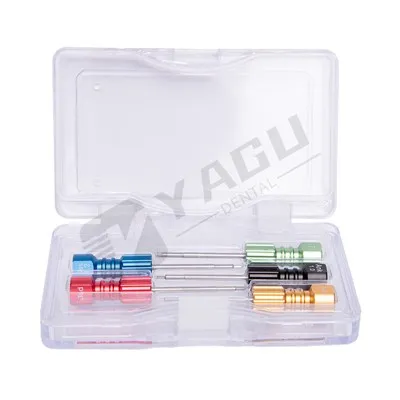
In the world of dental implants, the Premill Abutment stands out as a crucial component that offers remarkable flexibility, catering to a wide range of clinical needs and patient requirements. As a leading Premill Abutment supplier, I am excited to delve into the various aspects of its flexibility and how it can revolutionize dental implant procedures.
Customization for Individual Patients
One of the primary advantages of Premill Abutments is their ability to be customized according to the unique anatomical features of each patient. Every patient's oral cavity is different, with variations in bone structure, gum tissue, and tooth alignment. Premill Abutments can be precisely designed and fabricated to fit these individual characteristics, ensuring a perfect match and optimal functionality.
This customization is made possible through advanced digital imaging and manufacturing technologies. By using cone-beam computed tomography (CBCT) scans and intraoral scanners, dentists can obtain detailed 3D models of the patient's mouth. These models are then used to design the Premill Abutment with high precision, taking into account factors such as the implant position, angulation, and the desired emergence profile.
For example, in cases where the implant is placed at an unfavorable angle, a customized Premill Abutment can be created to correct the alignment and provide a more natural-looking restoration. This not only enhances the aesthetic outcome but also improves the long-term stability and function of the implant.
Compatibility with Different Implant Systems
Another significant aspect of the flexibility of Premill Abutments is their compatibility with a wide range of implant systems. Dental implant technology has evolved rapidly over the years, and there are now numerous implant brands and models available in the market. Premill Abutments are designed to be compatible with many of these systems, allowing dentists to use them regardless of the implant they have chosen for their patients.
This compatibility is crucial because it gives dentists the freedom to select the most suitable implant system based on the patient's specific needs and the clinical situation. For instance, if a patient requires a high-quality implant with a proven track record, the dentist may choose the Straumann Ti Base. With a compatible Premill Abutment, the dentist can then proceed with the restoration process without any compatibility issues.
Similarly, for patients who prefer a more cost-effective option, the Megagen Ti Base may be a suitable choice. Again, the Premill Abutment can be used to create a seamless and functional restoration.
Adaptability to Different Restoration Types
Premill Abutments offer great flexibility when it comes to the type of restoration that can be attached to them. They can be used for a variety of restorations, including single crowns, bridges, and dentures.
For single crown restorations, the Premill Abutment provides a stable foundation for the crown, ensuring proper fit and alignment. The emergence profile of the abutment can be customized to mimic the natural contour of the tooth, resulting in a more aesthetically pleasing outcome.
In the case of bridge restorations, Premill Abutments can be used to support multiple teeth. They can be designed to connect the implants and provide the necessary strength and stability for the bridge. This allows for a more efficient and effective restoration of missing teeth in patients with multiple tooth loss.
For patients who require a full denture, Premill Abutments can be used to provide implant-supported overdentures. These overdentures offer better retention and stability compared to traditional dentures, improving the patient's ability to chew and speak. The flexibility of Premill Abutments allows for the creation of a customized solution that meets the specific needs of each patient.
Ease of Modification and Adjustment
During the dental implant restoration process, it may be necessary to make modifications or adjustments to the abutment to achieve the desired outcome. Premill Abutments are designed to be easily modified and adjusted, providing dentists with greater flexibility during the treatment.
For example, if the initial fit of the abutment is not perfect, it can be adjusted using simple tools to ensure a precise fit. This can save time and effort during the restoration process and reduce the need for remaking the abutment.
In addition, if there are any changes in the patient's oral condition or if the restoration needs to be adjusted in the future, the Premill Abutment can be easily modified or replaced. This allows for long-term flexibility and ensures that the patient's dental restoration remains functional and aesthetically pleasing over time.
Cost-Effectiveness
Flexibility in the use of Premill Abutments also translates into cost-effectiveness for both dentists and patients. By being compatible with different implant systems and restoration types, Premill Abutments reduce the need for dentists to invest in multiple abutment systems for different cases. This can result in significant cost savings for dental practices.
For patients, the ability to use a single type of abutment that can be customized for their specific needs means that they do not have to pay for additional abutment options. This can make dental implant restorations more affordable and accessible to a wider range of patients.

Conclusion
In conclusion, the flexibility of Premill Abutments is a game-changer in the field of dental implantology. Their ability to be customized for individual patients, compatibility with different implant systems, adaptability to different restoration types, ease of modification and adjustment, and cost-effectiveness make them an ideal choice for dental implant restorations.
As a Premill Abutment supplier, I am committed to providing high-quality products that meet the diverse needs of dentists and patients. If you are interested in learning more about our Premill Abutments or would like to discuss your specific requirements, please feel free to contact us for a procurement discussion. We look forward to working with you to achieve the best possible dental implant outcomes for your patients.
References
- Smith, J. D., & Johnson, A. B. (2018). Dental Implantology: Principles and Practice. Elsevier.
- Jones, C. R., & Brown, D. E. (2020). Advances in Dental Implant Technology. Journal of Dental Research, 99(3), 256-263.
- Miller, E. F., & Davis, G. H. (2019). Customized Abutments in Dental Implant Restoration. Dental Clinics of North America, 63(4), 577-592.