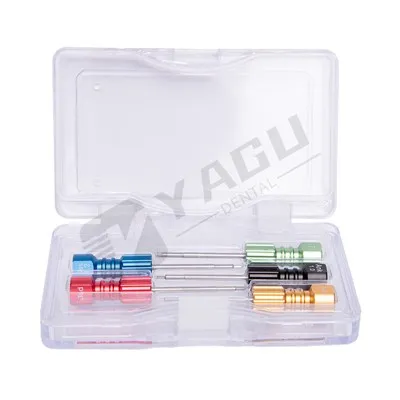
Dimensional tolerance is a critical aspect in the manufacturing and application of dental components, especially for Premill Abutments. As a supplier of Premill Abutments, I understand the significance of dimensional tolerance in ensuring the quality, fit, and functionality of these products. In this blog, I will delve into what dimensional tolerance is in the context of Premill Abutments, its importance, and how it impacts the overall dental restoration process.
Understanding Dimensional Tolerance
Dimensional tolerance refers to the allowable variation in the size, shape, and location of a manufactured part from its specified dimensions. In the case of Premill Abutments, these components are designed to precise specifications to ensure a proper fit with dental implants and dental restorations. However, due to the limitations of manufacturing processes, it is impossible to produce parts with exact dimensions every time. Therefore, dimensional tolerances are established to define the acceptable range of variation.
For example, if a Premill Abutment is specified to have a diameter of 5.00 mm, the dimensional tolerance might be set at ±0.05 mm. This means that the actual diameter of the abutment can range from 4.95 mm to 5.05 mm and still be considered within the acceptable limits. Tolerances are typically expressed in linear measurements (such as millimeters or inches) or angular measurements (such as degrees) depending on the feature being specified.
Importance of Dimensional Tolerance in Premill Abutments
1. Fit with Dental Implants
One of the primary reasons why dimensional tolerance is crucial for Premill Abutments is to ensure a proper fit with dental implants. Dental implants are surgically placed in the jawbone to serve as artificial tooth roots, and Premill Abutments are attached to these implants to support dental restorations such as crowns, bridges, or dentures. If the dimensional tolerance of the abutment is too large, it may not fit securely onto the implant, leading to instability, micro - movements, and potential loosening over time. On the other hand, if the tolerance is too small, the abutment may not fit onto the implant at all, requiring additional adjustments or even replacement of the part.
2. Compatibility with Dental Restorations
In addition to fitting with dental implants, Premill Abutments must also be compatible with dental restorations. The dimensional accuracy of the abutment affects the fit, aesthetics, and function of the final restoration. For example, if the height or diameter of the abutment is not within the specified tolerance, it can cause problems with the seating of the crown or bridge, resulting in poor occlusion (bite alignment) and potential damage to the restoration or adjacent teeth.


3. Biocompatibility and Patient Comfort
Proper dimensional tolerance also contributes to the biocompatibility and patient comfort of Premill Abutments. A well - fitting abutment reduces the risk of food impaction, plaque accumulation, and gum inflammation around the implant site. This helps to maintain the health of the surrounding tissues and improves the long - term success of the dental restoration.
Factors Affecting Dimensional Tolerance in Premill Abutments
1. Manufacturing Processes
The manufacturing process used to produce Premill Abutments has a significant impact on dimensional tolerance. Common manufacturing methods include machining, casting, and 3D printing. Each process has its own inherent limitations and sources of error.
Machining, such as CNC (Computer Numerical Control) machining, is a highly precise manufacturing process that can achieve relatively tight tolerances. However, factors such as tool wear, machine vibration, and programming errors can still affect the dimensional accuracy of the final part.
Casting involves pouring molten metal into a mold to create the abutment. This process can introduce variations in the size and shape of the part due to factors such as shrinkage during solidification, mold defects, and porosity.
3D printing, also known as additive manufacturing, builds the abutment layer by layer. While it offers the advantage of complex geometries, issues such as layer thickness variation, material shrinkage, and surface roughness can influence dimensional tolerance.
2. Material Properties
The material used to make Premill Abutments also plays a role in dimensional tolerance. Different materials have different physical and mechanical properties, such as thermal expansion, elasticity, and hardness. These properties can affect the dimensional stability of the part during manufacturing, processing, and use.
For example, titanium is a commonly used material for Premill Abutments due to its excellent biocompatibility and strength. However, titanium has a relatively high coefficient of thermal expansion, which means that it can expand or contract significantly with changes in temperature. This can lead to dimensional changes in the abutment if it is exposed to extreme temperatures during manufacturing or use.
3. Quality Control Measures
Effective quality control measures are essential for ensuring that Premill Abutments meet the specified dimensional tolerance. This includes inspection and testing at various stages of the manufacturing process, such as raw material inspection, in - process inspection, and final product inspection.
Inspection methods can include manual measurement using calipers, micrometers, and gauges, as well as automated measurement techniques such as coordinate measuring machines (CMMs) and optical scanners. These tools allow for accurate measurement of the dimensions, shape, and surface finish of the abutment, and help to identify any deviations from the specified tolerance.
Our Commitment to Dimensional Accuracy
As a supplier of Premill Abutments, we are committed to providing high - quality products with tight dimensional tolerances. We use state - of - the - art manufacturing equipment and advanced quality control systems to ensure the accuracy and consistency of our products.
Our manufacturing process starts with the selection of high - quality raw materials that meet strict standards for purity and composition. We then use precision machining techniques to produce the abutments, with careful attention to tool selection, cutting parameters, and machine calibration.
Throughout the manufacturing process, we conduct regular in - process inspections to monitor the dimensional accuracy of the parts. At the final stage, each abutment undergoes a comprehensive inspection using advanced measurement equipment to ensure that it meets our strict quality standards.
In addition to our in - house quality control measures, we also work closely with our customers to understand their specific requirements and provide customized solutions. We believe that by maintaining tight dimensional tolerances, we can help our customers achieve better clinical outcomes and patient satisfaction.
Related Products
If you are interested in other dental implant parts related to Premill Abutments, we also offer a range of high - quality products, including Dentium Lab Model Analog, Pre Milled Abutment, and Osstem Multi Unit 3D Analog. These products are designed to work seamlessly with our Premill Abutments and other dental implant systems, providing you with a complete solution for your dental restoration needs.
Contact Us for Procurement
If you are in the market for high - quality Premill Abutments or other dental implant parts, we invite you to contact us for procurement. Our team of experts is ready to assist you with product selection, technical support, and pricing information. We are committed to providing you with the best products and services to meet your specific needs.
References
- ISO 13399 - 1:2016, Cutting tools data representation and exchange — Part 1: General information and reference geometry model for cutting tool components
- ADA Specification No. 158, Dental implants — Implant - abutment connection
- ASTM F136 - 13, Standard Specification for Wrought Titanium - 6 Aluminum - 4 Vanadium ELI Alloy for Surgical Implant Applications (UNS R56401)