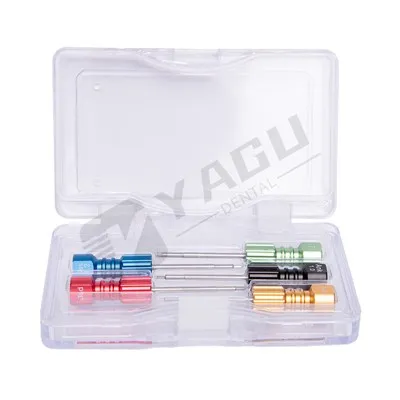
As a supplier of Osstem Temporary Abutment, I've delved deep into the intricacies of its design principle. In this blog, I'll share with you the underlying concepts that make Osstem Temporary Abutment a remarkable product in the dental implant field.

1. Understanding the Role of Temporary Abutments in Dental Implants
Before we explore the design principle of Osstem Temporary Abutment, it's essential to understand the general role of temporary abutments in dental implant procedures. Temporary abutments serve as a crucial link between the implant fixture and the temporary restoration. They are used during the healing phase of the implant site to maintain the proper space and contour for the future permanent restoration. They also help in guiding the soft - tissue healing around the implant, ensuring a healthy and aesthetically pleasing emergence profile.
2. Biocompatibility - A Fundamental Design Aspect
One of the primary design principles of Osstem Temporary Abutment is biocompatibility. The material used in these abutments is carefully selected to be compatible with the human body. Titanium is a common choice for Osstem Temporary Abutments. Titanium has excellent biocompatibility, which means it is well - tolerated by the body tissues. It doesn't cause adverse reactions such as inflammation or immune responses. This property is vital as it allows for a smooth integration of the abutment with the surrounding soft and hard tissues. When the body accepts the abutment well, the healing process is more efficient, and the risk of complications is significantly reduced.

3. Precision Fit and Connection
Precision fit is another key design principle. Osstem Temporary Abutments are engineered to have an exact fit with the implant fixture. The connection between the abutment and the implant is designed to be stable and secure. A proper fit ensures that there is no micro - movement between the abutment and the implant during the healing process. Micro - movement can lead to bone resorption around the implant, which can compromise the long - term success of the implant.

The connection design also plays a role in the transfer of occlusal forces. When a patient bites down, the forces need to be evenly distributed from the abutment to the implant and then to the surrounding bone. Osstem's design ensures that these forces are transferred in a way that minimizes stress concentration on any particular area, protecting the implant and the supporting bone structure.
4. Soft - Tissue Management
The design of Osstem Temporary Abutment takes into account soft - tissue management. The shape and contour of the abutment are carefully crafted to guide the soft - tissue growth and development. A well - designed abutment will help in creating a natural - looking emergence profile for the future permanent restoration. It promotes the formation of a healthy gingival seal around the abutment, which is essential for preventing bacteria from entering the implant site and causing infections.
The surface finish of the abutment also affects soft - tissue interaction. A smooth surface finish can reduce plaque accumulation and make it easier for the soft tissues to attach and maintain a healthy state. Osstem may use special surface treatments on their temporary abutments to enhance these properties.
5. Aesthetics and Customization
In modern dentistry, aesthetics are of great importance. Osstem Temporary Abutments are designed with aesthetics in mind. They can be customized to match the patient's natural dentition and soft - tissue color and contour. This customization allows for a more seamless transition between the implant - supported restoration and the surrounding teeth, resulting in a more natural and pleasing appearance.
Moreover, the ability to customize the abutment also means that dentists can address specific patient needs and preferences. For example, in cases where the patient has a unique bite or occlusion pattern, the abutment can be adjusted accordingly to ensure proper function and comfort.
6. Ease of Use and Clinical Efficiency
From a clinical perspective, the design of Osstem Temporary Abutment emphasizes ease of use and clinical efficiency. The abutments are designed to be easy to install and remove. This reduces the time and effort required during the dental procedure, making it more convenient for both the dentist and the patient.
The packaging and labeling of Osstem Temporary Abutments are also designed to be user - friendly. Dentists can easily identify the correct abutment size and type for each patient, reducing the risk of errors during the treatment process.
7. Compatibility with Other Dental Components
Osstem Temporary Abutments are designed to be compatible with a wide range of other dental components. They can be used in conjunction with [Dentium Multi Unit Scanbody]( /implant - parts/dentium - multi - unit - scanbody.html), [Ti Base Abutment]( /implant - parts/ti - base - abutment.html), and [Premill Abutment]( /implant - parts/premill - abutment.html). This compatibility allows for greater flexibility in treatment planning and the ability to create comprehensive dental implant solutions.
For example, when using a multi - unit scanbody, the temporary abutment needs to be able to connect properly to ensure accurate digital impressions. The compatibility with Ti Base Abutments and Premill Abutments means that dentists can choose the most appropriate combination of components based on the patient's specific case.
Contact for Procurement
If you are interested in Osstem Temporary Abutments or have any questions about our products, I encourage you to reach out to us for a procurement discussion. We are committed to providing high - quality products and excellent customer service. Whether you are a dental clinic, a distributor, or an individual dentist, we are here to meet your needs.
References
- Misch, C. E. (2018). Contemporary Implant Dentistry. Elsevier.
- Tarnow, D. P., Magner, A. W., & Fletcher, P. (1992). The effect of the distance from the contact point to the crest of bone on the presence or absence of the interproximal dental papilla. Journal of Periodontology, 63(11), 995 - 996.
- Linkow, L. I. (1969). Subperiosteal implant: A ten - year report. Journal of Oral Implantology, 1(1), 3 - 12.