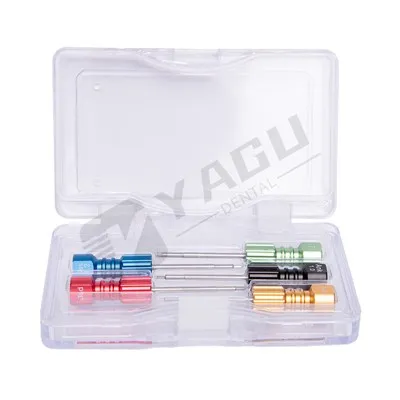
Hey there! As a supplier of Multi Unit Abutments, I'm super excited to take you through the manufacturing process of these crucial dental components. Multi Unit Abutments play a vital role in dental implant procedures, providing a stable connection between the implant and the dental restoration. So, let's dive right in and explore the steps involved in making these amazing products.
Step 1: Material Selection
The first step in the manufacturing process is choosing the right material. We typically use high - quality titanium or titanium alloys for Multi Unit Abutments. Titanium is an ideal choice because it's biocompatible, which means it can integrate well with the human body without causing any adverse reactions. It's also strong and corrosion - resistant, ensuring the longevity of the abutment.
We source our titanium from trusted suppliers who meet strict quality standards. This way, we can guarantee that our Multi Unit Abutments are of the highest quality.
Step 2: Design and CAD Modeling
Once we have the material, the next step is to design the Multi Unit Abutment. Our team of experienced designers uses Computer - Aided Design (CAD) software to create detailed 3D models of the abutment.
During this stage, we take into account various factors such as the shape, size, and angle of the abutment. Different patients have different dental needs, so we design our Multi Unit Abutments to be customizable. For example, we offer Multi Angled Abutment and Angled Multi Unit Abutments to accommodate different implant angles and patient anatomies. We also have Straight Abutment for cases where a straight connection is required.
The CAD models allow us to visualize the final product and make any necessary adjustments before moving on to the manufacturing phase. It's like creating a blueprint for the abutment.
Step 3: CNC Machining
After the design is finalized, it's time for the actual manufacturing. We use Computer Numerical Control (CNC) machining to turn the titanium material into the desired Multi Unit Abutment shape.
CNC machining is a highly precise process. The CNC machine follows the instructions from the CAD model to cut, drill, and shape the titanium. It can achieve very tight tolerances, ensuring that each abutment meets our strict quality control standards. This precision is crucial because even a small deviation in the dimensions of the abutment can affect its fit and performance in the patient's mouth.
Step 4: Surface Treatment
Once the abutment is machined, we perform surface treatment to enhance its properties. One common surface treatment is sandblasting. Sandblasting creates a rough surface on the abutment, which helps to improve the bonding between the abutment and the dental restoration.
We also apply a special coating to the abutment. This coating can further enhance the biocompatibility and corrosion resistance of the abutment. It also makes the abutment more resistant to wear and tear, ensuring its long - term performance.
Step 5: Quality Control
Quality control is an essential part of the manufacturing process. We have a rigorous quality control system in place to ensure that every Multi Unit Abutment we produce meets the highest standards.
We use a variety of inspection methods, including dimensional inspection, surface finish inspection, and material analysis. Our quality control team checks each abutment for any defects or deviations from the design specifications. Only abutments that pass all the quality control tests are approved for use.
Step 6: Packaging and Sterilization
After passing the quality control tests, the Multi Unit Abutments are carefully packaged. We use sterile packaging materials to ensure that the abutments remain clean and free from contamination during storage and transportation.


The packaged abutments are then sterilized. We use methods such as autoclaving or gamma irradiation to kill any microorganisms on the abutment. Sterilization is crucial because the abutment will be placed inside the patient's mouth, and any contamination could lead to infection.
Step 7: Distribution
Once the abutments are packaged and sterilized, they are ready for distribution. We work with a network of dental suppliers and distributors to get our Multi Unit Abutments to dental clinics and hospitals around the world.
We ensure that the abutments are delivered in a timely manner and in good condition. Our goal is to provide our customers with high - quality products and excellent service.
If you're in the market for Multi Unit Abutments, we'd love to hear from you. Whether you're a dental clinic, a hospital, or a dental supplier, we can offer you high - quality Multi Unit Abutments at competitive prices. Our products are backed by our commitment to quality and customer satisfaction. So, don't hesitate to reach out to us for more information or to start a procurement discussion.
References
- Dental Implant Technology: Principles and Practice, by various authors
- Journal of Oral and Maxillofacial Implants
- International Journal of Oral and Maxillofacial Surgery