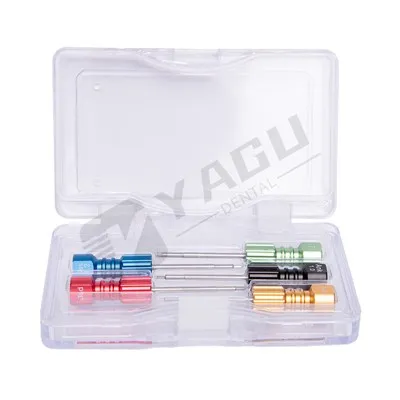
As a supplier of Multi Unit Abutments, I understand the critical importance of quality control standards in the dental implant industry. Multi Unit Abutments play a pivotal role in dental restorations, providing support and connection between dental implants and prosthetic teeth. Ensuring high - quality Multi Unit Abutments is not only a matter of meeting regulatory requirements but also of guaranteeing patient safety and satisfaction. In this blog, I will delve into the key quality control standards for Multi Unit Abutments.
Material Quality
The first and foremost aspect of quality control for Multi Unit Abutments is the selection and quality of materials. These abutments are typically made from materials such as titanium or zirconia. Titanium is widely used due to its excellent biocompatibility, corrosion resistance, and mechanical strength. Zirconia, on the other hand, offers high aesthetic appeal and is also biocompatible.
For titanium Multi Unit Abutments, the titanium should meet specific purity standards. Usually, medical - grade titanium, such as titanium alloy Ti - 6Al - 4V, is preferred. This alloy contains 6% aluminum and 4% vanadium, which enhances its mechanical properties while maintaining biocompatibility. The raw titanium material should be sourced from reliable suppliers who can provide certificates of analysis indicating the chemical composition and purity.
In the case of zirconia Multi Unit Abutments, the zirconia powder used in the manufacturing process must have a high degree of purity and uniform particle size. High - purity zirconia ensures better mechanical strength and translucency, which are important for both the durability and aesthetic appearance of the abutment. The zirconia should also be tested for phase stability to prevent transformation - related failures.
Dimensional Accuracy
Dimensional accuracy is crucial for Multi Unit Abutments as they need to fit precisely with dental implants and prosthetic components. Any deviation in dimensions can lead to improper seating, poor stability, and even failure of the dental restoration.
The diameter, height, and internal and external thread dimensions of the Multi Unit Abutment must be within strict tolerances. For example, the diameter of the connection part with the dental implant should be accurate to within a few micrometers. This ensures a tight and secure fit, preventing micro - movements that can cause bone resorption and implant failure over time.
The angulation of angled Multi Unit Abutments Angled Abutment Implant also needs to be precisely controlled. Even a small deviation in the angulation can affect the alignment of the prosthetic tooth, leading to occlusal problems and discomfort for the patient.
Surface Finish
The surface finish of Multi Unit Abutments has a significant impact on their performance. A smooth surface finish reduces the risk of bacterial adhesion, which is important for preventing peri - implantitis, an inflammatory condition around the dental implant.
The surface roughness of the abutment should be carefully controlled. Generally, a smooth surface with a roughness value (Ra) of less than 0.2 micrometers is preferred. This can be achieved through processes such as polishing and grinding. Additionally, the surface should be free from any scratches, pits, or other defects that could provide a niche for bacterial growth.


For some Multi Unit Abutments, surface treatments may be applied to enhance osseointegration (the process by which the implant fuses with the surrounding bone). These treatments can include sand - blasting, acid - etching, or the application of bioactive coatings. The quality of these surface treatments also needs to be monitored to ensure consistent results.
Mechanical Properties
Multi Unit Abutments are subjected to various mechanical forces during normal chewing and biting. Therefore, they must possess adequate mechanical properties to withstand these forces without deformation or fracture.
Tensile strength, yield strength, and fatigue resistance are important mechanical properties to consider. The tensile strength of the abutment material should be sufficient to resist the pulling forces applied during chewing. Yield strength indicates the stress at which the material begins to deform permanently. A high yield strength ensures that the abutment can maintain its shape under normal loading conditions.
Fatigue resistance is particularly important as the abutment will experience repeated loading cycles over time. Abutments with poor fatigue resistance are more likely to fail due to crack initiation and propagation. To ensure good fatigue resistance, the manufacturing process should be carefully controlled to minimize internal defects and stress concentrations.
Compatibility
Compatibility is another key quality control aspect for Multi Unit Abutments. They need to be compatible with different types of dental implants and prosthetic components.
The connection between the Multi Unit Abutment and the dental implant should be designed to ensure a proper fit and mechanical stability. There are different types of implant - abutment connections, such as Morse taper, internal hex, and external hex connections. The Multi Unit Abutment should be compatible with the specific connection type of the implant it is intended to be used with.
In addition, the Multi Unit Abutment should be compatible with the prosthetic materials used for the final restoration, such as ceramic crowns or acrylic dentures. Compatibility in terms of color, bonding strength, and mechanical properties is essential to achieve a successful and long - lasting dental restoration.
Sterilization and Packaging
Proper sterilization and packaging are essential to maintain the quality of Multi Unit Abutments during storage and transportation. The abutments should be sterilized using validated methods, such as steam sterilization, ethylene oxide sterilization, or gamma irradiation.
The sterilization process should be carefully monitored to ensure that all microorganisms are effectively eliminated. Sterility indicators should be used to confirm the effectiveness of the sterilization process. After sterilization, the Multi Unit Abutments should be packaged in a way that protects them from contamination. The packaging materials should be clean, non - toxic, and provide a barrier against moisture, dust, and microorganisms.
Quality Assurance and Testing
To ensure that Multi Unit Abutments meet the required quality control standards, a comprehensive quality assurance program should be in place. This program should include incoming material inspection, in - process inspection, and final product testing.
Incoming material inspection involves verifying the quality of raw materials, such as titanium or zirconia, before they are used in the manufacturing process. This includes checking the chemical composition, purity, and dimensional accuracy of the materials.
In - process inspection is carried out during the manufacturing process to detect and correct any quality issues early. This can involve monitoring the machining operations, surface treatments, and assembly processes.
Final product testing includes a series of tests to evaluate the dimensional accuracy, mechanical properties, surface finish, and compatibility of the Multi Unit Abutments. Non - destructive testing methods, such as ultrasonic testing and X - ray inspection, can be used to detect internal defects. Destructive testing, such as tensile testing and fatigue testing, can also be performed on a sample basis to ensure the overall quality of the product.
Conclusion
In conclusion, quality control standards for Multi Unit Abutments are multi - faceted and cover aspects such as material quality, dimensional accuracy, surface finish, mechanical properties, compatibility, sterilization, and packaging. As a supplier, it is our responsibility to adhere to these standards to provide high - quality products that meet the needs of dental professionals and patients.
If you are interested in purchasing high - quality Multi Unit Abutments, including Straight Abutment and Straumann Multi Unit Abutment, we are here to offer you reliable solutions. Please feel free to contact us for further discussion and procurement negotiation.
References
- Misch CE. Contemporary Implant Dentistry. Mosby; 2008.
- Zarb GA, Albrektsson T, editors. Textbook of Oral Implantology. Quintessence Publishing; 1990.
- Buser D, Martin W, Belser UC. Optimizing esthetics for implant restorations with short clinical crowns: anatomic and surgical considerations. The International Journal of Oral & Maxillofacial Implants. 2004;19 Suppl:43 - 61.