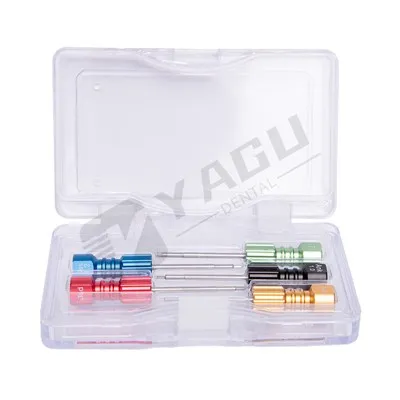
When it comes to dental implants, the journey from implant placement to the final restoration is crucial for both patients and dentists. One key component that plays a significant role in this transition is the temporary abutment. As a temporary abutment supplier, I've seen firsthand how these little pieces can make a big difference. In this blog, I'll break down how a temporary abutment helps in this transition process.
Understanding the Basics of Dental Implants
Before we dive into the role of temporary abutments, let's quickly go over the basics of dental implants. A dental implant is a titanium post that's surgically placed into the jawbone to replace the root of a missing tooth. Once the implant fuses with the jawbone through a process called osseointegration, it provides a stable foundation for a replacement tooth, like a crown, bridge, or denture.
The process of getting a dental implant usually involves several steps. First, the dentist places the implant into the jawbone. After a healing period (usually a few months), the dentist then attaches an abutment to the implant. The abutment serves as a connector between the implant and the final restoration. And this is where the temporary abutment comes in.
The Role of Temporary Abutments in the Transition
Healing and Tissue Management
One of the primary functions of a temporary abutment is to aid in the healing process after implant placement. When the implant is first placed, the surrounding gum tissue needs time to heal and adapt to the new structure. The temporary abutment helps create a proper emergence profile for the gum tissue. This means it shapes the gum tissue around the implant in a way that looks natural and healthy.
For example, if the gum tissue doesn't form correctly around the implant, it can lead to issues like gum recession or an unnatural appearance of the final restoration. By using a temporary abutment, the dentist can guide the growth of the gum tissue and ensure that it heals in the right way. This is especially important for achieving a good aesthetic outcome.
Function and Patient Comfort
During the healing period, patients still need to be able to eat and speak normally. A temporary abutment allows for this. It can be used to attach a temporary restoration, like a temporary crown or bridge. This gives the patient a functional tooth replacement while they wait for the final restoration.
The temporary restoration attached to the temporary abutment also helps the patient get used to the feeling of having an implant in their mouth. It allows them to adjust to the new bite and chewing forces. This can make the transition to the final restoration much smoother.
Evaluation and Adjustment
Another advantage of using a temporary abutment is that it gives the dentist time to evaluate the fit and function of the implant and the surrounding tissues. The dentist can check how the gum tissue is healing, how the patient is adapting to the temporary restoration, and whether any adjustments need to be made.
For instance, if the bite is off or if the gum tissue isn't looking right, the dentist can make changes to the temporary abutment or the temporary restoration. This can help prevent problems with the final restoration. By making these adjustments early on, the dentist can ensure that the final restoration fits perfectly and looks great.
Types of Temporary Abutments
There are different types of temporary abutments available, each with its own advantages.
Casting Abutment
A Casting Abutment is a type of temporary abutment that's custom-made for each patient. It's created by casting a metal alloy around a model of the implant. This allows for a precise fit and can be designed to match the specific needs of the patient. Casting abutments are often used when a high level of accuracy is required, especially for complex cases.


Pre Milled Abutment
Pre Milled Abutment are pre-fabricated abutments that are available in a variety of sizes and shapes. They're made from materials like titanium or zirconia. Pre milled abutments are a popular choice because they're readily available and can be quickly adjusted to fit the patient's needs. They're also more cost-effective than custom-cast abutments.
Premill Abutment
Premill Abutment are similar to pre milled abutments. They're pre-manufactured and can be easily customized to fit the implant and the patient's mouth. Premill abutments offer a good balance between cost, convenience, and accuracy.
The Supplier's Perspective
As a temporary abutment supplier, I understand the importance of providing high-quality products. Our temporary abutments are made from the best materials and are designed to meet the strictest standards of quality and safety.
We work closely with dentists and dental laboratories to ensure that our products are easy to use and provide the best possible results. We also offer a wide range of options to meet the diverse needs of different patients and cases. Whether it's a casting abutment for a complex case or a pre milled abutment for a more straightforward implant, we've got you covered.
Contact Us for Your Temporary Abutment Needs
If you're a dentist or a dental laboratory looking for high-quality temporary abutments, we'd love to hear from you. Our team of experts is always ready to answer your questions and help you find the right products for your patients. Whether you need a small order for a few cases or a large order for your practice, we can provide you with the supplies you need.
Contact us today to start a conversation about your temporary abutment needs. Let's work together to ensure the best possible outcomes for your patients' dental implant treatments.
References
- Misch, C. E. (2018). Dental Implant Prosthetics. Elsevier Health Sciences.
- Tarnow, D. P., Magner, A. W., & Fletcher, P. (1992). The effect of the distance from the contact point to the crest of bone on the presence or absence of the interproximal dental papilla. Journal of Periodontology, 63(12), 995-996.
- Zitzmann, N. U., & Marinello, C. P. (2008). Soft tissue management at dental implants. Periodontology 2000, 46(1), 30-42.