


Introduction
The premill abutment is a partially pre-machined titanium blank that gives dental laboratories a validated implant connection while leaving the emergence profile and coping geometry open for chairside or in-lab CAD/CAM milling. Also referred to as a premilled abutment or premill blank, the component ships with the implant-mating interface already finished to final tolerance, so the technician only mills the supragingival portion that defines the restoration. This division of labor is what makes the premilled abutment central to modern screw-retained and cement-retained custom abutment workflows.
Each Yagu premill abutment is machined from Ti-6Al-4V ELI Grade 5 titanium on Japan-imported CITIZEN Swiss CNC centers, holding the connection geometry to a ±5 μm precision tolerance. Because the anti-rotational index, seating platform, and screw seat are cut before the blank leaves the factory, the milled result seats passively on the implant without the operator having to correct the interface. The premill blank is supplied with a pre-machined holder or milling adapter footprint compatible with common laboratory milling units, allowing direct fixturing without secondary setup. For laboratories producing custom titanium abutments across multiple implant platforms, the premilled abutment standardizes the one dimension that must never vary - the implant interface - while preserving full design freedom above the gingival margin.
Key Features
Factory-finished implant interface at ±5 μm tolerance.
The connection geometry, anti-rotation flats, and seating shoulder are CNC-machined before shipment, so the milled abutment achieves passive fit without post-milling adjustment of the interface.
Ti-6Al-4V ELI Grade 5 titanium billet, ASTM F136 compliant.
The blank is cut from certified medical-grade bar stock, giving the finished abutment high fatigue strength and biocompatibility suitable for long-term intraoral service.
Pre-machined milling adapter footprint.
A standardized holder interface lets the blank be fixtured directly in laboratory milling machines, reducing setup error and clamping runout during the milling cycle.
Defined milling envelope.
Each blank supplies enough titanium above the interface to mill angulated emergence profiles, subgingival contours, and screw-access channels for angulated screw-retained designs.
Machined surface on the interface, unpolished milling zone.
The mating surface is finished for metal-to-metal contact, while the milling zone is left as-cut to accept the technician's final geometry and surface treatment.
Engaging and non-engaging versions.
Engaging blanks are used for single-unit restorations that require anti-rotation; non-engaging blanks support multi-unit splinted frameworks with a shared path of insertion.
Connection-specific inventory.
Blanks are stocked per implant connection rather than as a single universal part, so the index and diameter match the target system exactly.
100% dimensional inspection of the interface.
Every lot is verified on the connection tolerances before release, documented under the ISO 13485 quality system.
Compatible Systems
Yagu premill abutments are produced as connection-specific blanks rather than a single universal blank, because the implant interface must match the target system without compromise. Blanks are stocked for Osstem TS III and Hiossen ET III, Megagen AnyRidge and AnyOne, Dentium SuperLine and Implantium, Straumann Bone Level and Bone Level Tapered, and Nobel Biocare NobelActive and conical connection platforms, among 80+ implant systems in the Yagu catalog. Each connection is validated by 100% interface compatibility testing against reference implant geometry before the blank is released.
Because the milling zone is system-independent, a single milling library and workflow can be used across brands while the factory-finished interface guarantees platform accuracy. All brand names are trademarks of their respective owners; Yagu Dental manufactures compatible components and is not affiliated with these companies.
Clinical Applications
Premill abutments support the fabrication of fully custom titanium abutments for both cement-retained and screw-retained restorations. In single-crown restoration, an engaging blank is milled to a patient-specific emergence profile that supports peri-implant soft tissue and positions the finish line relative to the gingival margin. For multiple-unit bridges and splinted frameworks, non-engaging blanks are milled to a common path of insertion so the framework seats passively across several implants.
The premilled approach is frequently used for angulated screw channel (ASC) abutments, where the access channel is redirected palatally or lingually to keep the screw out of an esthetic or occlusal surface. Because the interface is factory-controlled to ±5 μm, the milled abutment seats passively - a prerequisite for reducing screw loosening, micromovement at the implant–abutment junction, and the marginal bone stress associated with a poorly fitting interface. Laboratories also use premill blanks to standardize hybrid workflows, milling the titanium base geometry for later veneering or for bonding of a zirconia superstructure. The result is a repeatable, connection-accurate custom abutment produced in-house on existing milling equipment.
Material & Manufacturing
The blank is machined from Ti-6Al-4V ELI Grade 5 titanium. The ELI (Extra Low Interstitial) designation specifies reduced oxygen, nitrogen, carbon, and iron content relative to standard Grade 5, which improves ductility and fracture toughness - properties that matter for a thin-walled abutment interface subjected to cyclic occlusal load. The alloy combines an elastic modulus close to that used across the implant restorative chain with high fatigue strength, supporting long-term stability of the screw joint. Its titanium-oxide passive layer provides the biocompatibility and corrosion resistance required for a component that contacts peri-implant tissue.
Manufacturing is performed on Japan-imported CITIZEN Swiss-type CNC machining centers, which hold the connection index, seating shoulder, and screw seat to ±5 μm. Material conformity is documented to ASTM F136 and ISO 5832-3. Every lot undergoes 100% dimensional inspection of the interface geometry before shipment, with connection tolerances verified against reference gauges under the company's ISO 13485 quality management system. Certificates of conformity and material traceability are available per lot.
Because the blank is finished by the laboratory after delivery, Yagu controls the two variables the lab cannot correct: the alloy's internal soundness and the interface geometry. Bar stock is sourced with mill certificates confirming chemistry and microstructure, and the machined interface is verified against connection gauges so the milled result seats without interface adjustment. The as-cut milling zone is left with sufficient stock and a predictable grain structure so it mills cleanly on carbide tooling without chatter or edge break-out, which protects the accuracy of the emergence profile the technician creates. Blanks are packaged individually with lot identification so material traceability follows the finished custom abutment through fabrication and delivery.
5,000+ m²
Machining facility
±5 μm
Interface tolerance
80+
Implant systems supported
1,000+
SKUs in stock
40+
Countries served
Premill Abutment
Titanium Premilled Blanks for Custom CAD/CAM Abutment Fabrication
The premill abutment is a partially pre-machined titanium blank that gives dental laboratories a validated implant connection while leaving the emergence profile and coping geometry open for chairside or in-lab CAD/CAM milling. Also referred to as a premilled abutment or premill blank, the component ships with the implant-mating interface already finished to final tolerance, so the technician only mills the supragingival portion that defines the restoration. This division of labor is what makes the premilled abutment central to modern screw-retained and cement-retained custom abutment workflows.
Each Yagu premill abutment is machined from Ti-6Al-4V ELI Grade 5 titanium on Japan-imported CITIZEN Swiss CNC centers, holding the connection geometry to a ±5 μm precision tolerance. Because the anti-rotational index, seating platform, and screw seat are cut before the blank leaves the factory, the milled result seats passively on the implant without the operator having to correct the interface. The premill blank is supplied with a pre-machined holder or milling adapter footprint compatible with common laboratory milling units, allowing direct fixturing without secondary setup. For laboratories producing custom titanium abutments across multiple implant platforms, the premilled abutment standardizes the one dimension that must never vary - the implant interface - while preserving full design freedom above the gingival margin.

:Technical content prepared and verified by Yagu Dental's engineering & QC team · Last technical review: July 21, 2026
Material
The material of our premill abutment is made of grade 5 titanium.
The features of grade 5 titanium:
1. Higher purity and smaller impurity content.
2. Better biocompatibility, can better integrate with surrounding bone tissue, and helps promote the healing and stability of implants.
3. Harder and more wear-resistant, with greater strength and hardness.
4. Better corrosion resistance than grade 4 titanium and can remain stable in harsher environments.
Key Features
Factory-finished implant interface at ±5 μm tolerance.
The connection geometry, anti-rotation flats, and seating shoulder are CNC-machined before shipment, so the milled abutment achieves passive fit without post-milling adjustment of the interface.
Ti-6Al-4V ELI Grade 5 titanium billet, ASTM F136 compliant.
The blank is cut from certified medical-grade bar stock, giving the finished abutment high fatigue strength and biocompatibility suitable for long-term intraoral service.
Pre-machined milling adapter footprint.
A standardized holder interface lets the blank be fixtured directly in laboratory milling machines, reducing setup error and clamping runout during the milling cycle.
Defined milling envelope.
Each blank supplies enough titanium above the interface to mill angulated emergence profiles, subgingival contours, and screw-access channels for angulated screw-retained designs.
Machined surface on the interface, unpolished milling zone.
The mating surface is finished for metal-to-metal contact, while the milling zone is left as-cut to accept the technician's final geometry and surface treatment.
Engaging and non-engaging versions.
Engaging blanks are used for single-unit restorations that require anti-rotation; non-engaging blanks support multi-unit splinted frameworks with a shared path of insertion.
Connection-specific inventory.
Blanks are stocked per implant connection rather than as a single universal part, so the index and diameter match the target system exactly.
100% dimensional inspection of the interface.
Every lot is verified on the connection tolerances before release, documented under the ISO 13485 quality system.
Compatible with
Titanium Pre-Mill
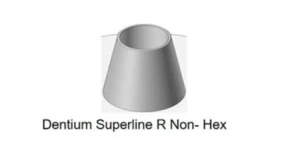
Dentium Superline regular, engaging, non-engaging interface (all in stock)

Specifications
Full lot documentation and certificates of conformity are available on request.
| Material | Ti-6Al-4V ELI Grade 5 titanium billet |
| Titanium Grade | Grade 5 ELI (Extra Low Interstitial), ASTM F136 |
| Precision Tolerance | ±5 μm on implant interface geometry |
| Surface Treatment | Machined interface; as-cut milling zone (TiN coating optional on finished part) |
| Thread Type | System-specific abutment screw seat (typ. M1.4–M2.0) |
| Platform Diameter(s) | Connection-specific (NP / RP / WP or system equivalent) |
| Sterilization | Supplied non-sterile; steam autoclave 134 °C before clinical use |
| Packaging Unit | Individually packed, 1 pc/pack, lot-traceable |
| Compatible Connection Type | Internal hex / conical, matched to target implant system |
|
Specification |
Detail |
|
Material |
Ti-6Al-4V ELI Grade 5 titanium billet |
|
Titanium Grade |
Grade 5 ELI (Extra Low Interstitial), ASTM F136 |
|
Precision Tolerance |
±5 μm on implant interface geometry |
|
Surface Treatment |
Machined interface; as-cut milling zone (TiN coating optional on finished part) |
|
Thread Type |
System-specific abutment screw seat (typ. M1.4–M2.0) |
|
Platform Diameter(s) |
Connection-specific (NP / RP / WP or system equivalent) |
|
Sterilization |
Supplied non-sterile; steam autoclave 134 °C before clinical use |
|
Packaging Unit |
Individually packed, 1 pc/pack, lot-traceable |
|
Compatible Connection Type |
Internal hex / conical, matched to target implant system |
Main Advantages
Time Efficient And Quicker Workflow
The use of dental titanium abutments can significantly enhance time efficiency and streamline workflows in several ways:
Faster Integration
Titanium's biocompatibility promotes quicker osseointegration, allowing for shorter healing times before the prosthetic can be placed.
01
Simplified Procedures
The precision of titanium components reduces the need for adjustments and remakes, leading to quicker restorations.
02
Reduced Chair Time
Efficient design and manufacturing processes mean fewer visits and less time spent in the dental chair for patients.
03
Pre-fabricated Options
Many titanium abutments come pre-fabricated, minimizing preparation time during the procedure.
04
Improved Digital Workflow
Integration with CAD/CAM technology allows for faster design and fabrication of dental prosthetics, enhancing overall workflow efficiency.
05
Compatible Systems
Yagu premill abutments are produced as connection-specific blanks rather than a single universal blank, because the implant interface must match the target system without compromise. Blanks are stocked for Osstem TS III and Hiossen ET III, Megagen AnyRidge and AnyOne, Dentium SuperLine and Implantium, Straumann Bone Level and Bone Level Tapered, and Nobel Biocare NobelActive and conical connection platforms, among 80+ implant systems in the Yagu catalog. Each connection is validated by 100% interface compatibility testing against reference implant geometry before the blank is released.
Because the milling zone is system-independent, a single milling library and workflow can be used across brands while the factory-finished interface guarantees platform accuracy.
Osstem TS III
Hiossen ET III
Megagen AnyRidge
Megagen AnyOne
Dentium SuperLine
Dentium Implantium
Straumann Bone Level
Straumann Bone Level Tapered
Nobel Biocare NobelActive
Conical Connection
Easier collaboration with your lab
Easier collaboration with your dental lab when using titanium abutments can be attributed to several factors:
Standardization
Titanium components often follow standardized designs, making it easier for labs to predict outcomes and streamline production.
Digital Impressions
The use of digital impressions and CAD/CAM technology allows for precise communication of designs, reducing errors and enhancing collaboration.
Consistent Quality
Titanium's durability and predictability in performance help labs produce consistent and reliable restorations.
Clear Communication
Many labs provide clear protocols and guidelines for titanium abutment cases, making it easier for dental professionals to relay specific requirements.
Faster Turnaround Times
With pre-fabricated titanium abutments and efficient workflows, labs can often deliver final products more quickly, facilitating better scheduling and patient management.
Flexibility in Design
Titanium allows for versatile design options, enabling labs to accommodate various case complexities without compromising quality.
Clinical Applications
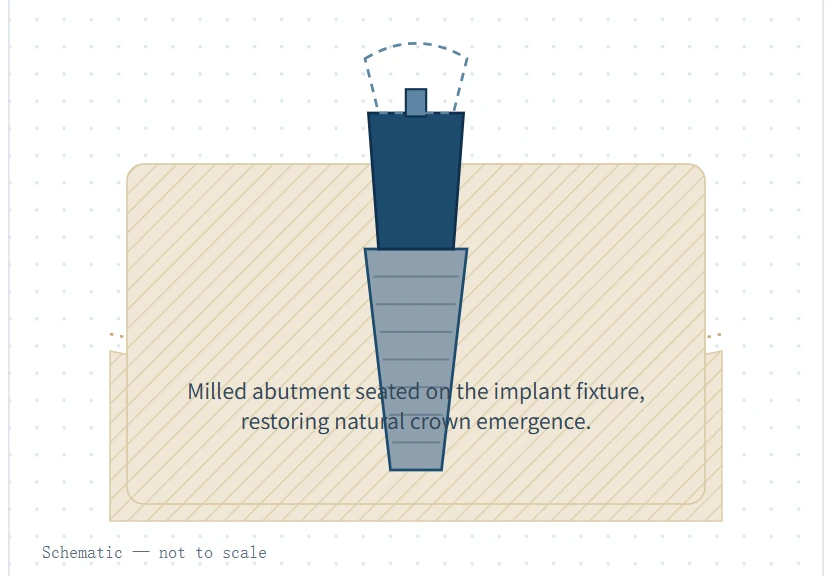
Premill abutments support the fabrication of fully custom titanium abutments for both cement-retained and screw-retained restorations. In single-crown restoration, an engaging blank is milled to a patient-specific emergence profile that supports peri-implant soft tissue and positions the finish line relative to the gingival margin. For multiple-unit bridges and splinted frameworks, non-engaging blanks are milled to a common path of insertion so the framework seats passively across several implants.
The premilled approach is frequently used for angulated screw channel (ASC) abutments, where the access channel is redirected palatally or lingually to keep the screw out of an esthetic or occlusal surface. Because the interface is factory-controlled to ±5 μm, the milled abutment seats passively - a prerequisite for reducing screw loosening, micromovement at the implant–abutment junction, and the marginal bone stress associated with a poorly fitting interface. Laboratories also use premill blanks to standardize hybrid workflows, milling the titanium base geometry for later veneering or for bonding of a zirconia superstructure. The result is a repeatable, connection-accurate custom abutment produced in-house on existing milling equipment.
Less Number Of Visits Required
Using titanium abutments can lead to fewer visits for patients due to several key factors:
Rapid Osseointegration
Titanium's excellent biocompatibility allows for quicker integration with bone, reducing the waiting time before placing the final restoration.
01
Pre-fabricated Options
Many titanium abutments come ready-made, minimizing the need for additional impressions or adjustments, which can reduce the number of appointments.
02
Efficient Workflow
Streamlined processes in both the dental practice and the lab mean that cases can be completed faster, often requiring fewer follow-up visits.
03
Digital Technology
The use of digital impressions and design can lead to more accurate results on the first try, reducing the need for corrections and additional appointments.
04
Reduced Complications
Titanium's strength and stability lower the likelihood of issues arising after placement, meaning fewer corrective visits are needed.
05
The blank is machined from Ti-6Al-4V ELI Grade 5 titanium. The ELI (Extra Low Interstitial) designation specifies reduced oxygen, nitrogen, carbon, and iron content relative to standard Grade 5, which improves ductility and fracture toughness - properties that matter for a thin-walled abutment interface subjected to cyclic occlusal load. The alloy combines an elastic modulus close to that used across the implant restorative chain with high fatigue strength, supporting long-term stability of the screw joint. Its titanium-oxide passive layer provides the biocompatibility and corrosion resistance required for a component that contacts peri-implant tissue.
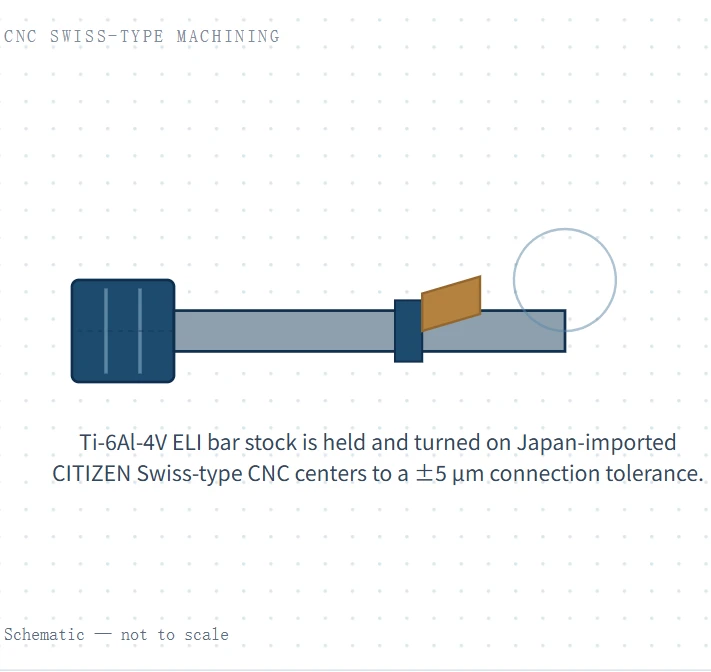
Manufacturing is performed on Japan-imported CITIZEN Swiss-type CNC machining centers, which hold the connection index, seating shoulder, and screw seat to ±5 μm. Material conformity is documented to ASTM F136 and ISO 5832-3. Every lot undergoes 100% dimensional inspection of the interface geometry before shipment, with connection tolerances verified against reference gauges under the company's ISO 13485 quality management system. Certificates of conformity and material traceability are available per lot.
Because the blank is finished by the laboratory after delivery, Yagu controls the two variables the lab cannot correct: the alloy's internal soundness and the interface geometry. Bar stock is sourced with mill certificates confirming chemistry and microstructure, and the machined interface is verified against connection gauges so the milled result seats without interface adjustment. The as-cut milling zone is left with sufficient stock and a predictable grain structure so it mills cleanly on carbide tooling without chatter or edge break-out, which protects the accuracy of the emergence profile the technician creates. Blanks are packaged individually with lot identification so material traceability follows the finished custom abutment through fabrication and delivery.
ISO 13485
Quality management
ASTM F136
Ti-6Al-4V ELI alloy
ISO 5832-3
Wrought titanium alloy
100%Inspected
Per-lot dimensional check
Cost-effective solution
Using titanium abutments can be a cost-effective solution for several reasons:
Durability
Titanium is highly durable and resistant to wear, which means fewer replacements and repairs over time, ultimately lowering long-term costs.
Fewer Complications
The reliability of titanium abutments reduces the likelihood of complications that can lead to additional treatments and expenses.
Streamlined Workflow
Efficient processes in both the dental office and the lab reduce chair time and associated costs, benefiting both the practice and the patient.
Long-term Success Rates
Titanium implants and abutments have high success rates, which translates to fewer failures and the need for costly redo procedures.
Pre-fabrication
Many titanium abutments are pre-fabricated, lowering manufacturing costs and reducing chair time for the dentist, making it an economically sound choice.
Insurance Coverage
Titanium implants are often covered by dental insurance plans, helping to offset costs for patients.
Sources & Standards Referenced
ASTM F136-13(2021) - Standard Specification for Wrought Ti-6Al-4V ELI Alloy for Surgical Implant Applications, ASTM International.
ISO 5832-3:2021 - Implants for Surgery, Metallic Materials, Part 3: Wrought Titanium 6-Aluminium 4-Vanadium Alloy, International Organization for Standardization.
ISO 13485:2016 - Medical Devices, Quality Management Systems, Requirements for Regulatory Purposes, International Organization for Standardization.
Yagu Dental's ISO 13485 certification and material conformity records are maintained internally and available for verification on request. Certificate registration number: [ISO 13485 Certificate No.], issued by [Certification Body Name].
Easy to fabricate and predictable results
Titanium abutments offer easy fabrication and predictable results for several reasons:
Standardized Manufacturing
Many titanium abutments are produced to standardized specifications, allowing for consistent quality and easier fabrication processes.
CAD/CAM Technology
The integration of computer-aided design and manufacturing enables precise designs that can be fabricated quickly and accurately, reducing the chance of errors.
Reliable Biocompatibility
Titanium's well-documented biocompatibility ensures that it integrates well with bone, leading to predictable healing and stability.
Established Protocols
Extensive clinical data and guidelines support the use of titanium abutments, making outcomes more predictable based on proven techniques.
Less Adjustment Needed
The precision of titanium components typically results in fewer adjustments during placement, contributing to smoother procedures and more reliable outcomes.
Versatile Applications
Titanium can be used in various clinical scenarios, providing flexibility and predictability in different treatment plans.
Why Choose Yagu

A Manufacturing Partner Built for Long-Term Procurement
Shenzhen Yagu Dental Technology Co., Ltd. is an ISO 13485 certified manufacturer of dental implant components, operating a 5,000+ m² production facility equipped with Japan-imported CITIZEN Swiss CNC machining centers. Every premill abutment is machined from 100% Medical Grade 5 titanium (Ti-6Al-4V ELI, ASTM F136) to a ±5 μm tolerance and inspected before shipment. With 80+ compatible implant systems, 1,000+ SKUs in stock, 10+ years of dental lab and clinical experience, and customers in 40+ countries, Yagu supports laboratories and distributors with consistent, connection-accurate blanks. OEM, ODM, and private-label options are available. Contact our technical team for custom solutions, or request a quote today.
Shenzhen Yagu Dental Technology Co., Ltd. is an ISO 13485 certified manufacturer of dental implant components, operating a 5,000+ m² production facility equipped with Japan-imported CITIZEN Swiss CNC machining centers. Every premill abutment is machined from 100% Medical Grade 5 titanium (Ti-6Al-4V ELI, ASTM F136) to a ±5 μm tolerance and inspected before shipment. With 80+ compatible implant systems, 1,000+ SKUs in stock, 10+ years of dental lab and clinical experience, and customers in 40+ countries, Yagu supports laboratories and distributors with consistent, connection-accurate blanks. OEM, ODM, and private-label options are available. Contact our technical team for custom solutions, or request a quote today.


Packaging

1 premill abutment + 2 screw in package (1 for lab + 1 for clinic)
Frequently Asked Questions

01.What is the MOQ for premill abutments?
02.How fast are samples and mass production?
03.How is compatibility with my implant system verified?
04.Do you offer OEM, ODM, and private-label premill blanks?
05.Are the blanks supplied sterile?
06.Which milling machines are the blanks compatible with?
Hot Tags: premill abutment, China premill abutment manufacturers, suppliers, factory, implant surface finish, implant part ceramics, arum premill abutment, tibase nobel biocare, nobel biocare tibase, premill abutment osstem


