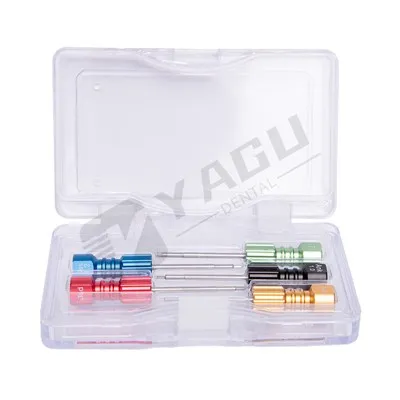
Hey there! As a supplier of Multi Angled Abutments, I've seen firsthand how these little wonders can make a huge difference in the world of dental prosthetics. So, let's dive into how multi angled abutments enhance the stability of dental prosthetics.
First off, what are multi angled abutments? Well, they're basically components that connect dental implants to the prosthetic teeth. Unlike traditional abutments that have a fixed angle, multi angled abutments can be adjusted to various angles. This flexibility is a game - changer when it comes to stability.
One of the main reasons multi angled abutments enhance stability is their ability to adapt to the natural anatomy of the patient's mouth. Every person's jawbone and gum tissue are unique. Sometimes, the implant may not be placed in a perfectly straight position due to the shape of the bone or other anatomical constraints. In such cases, a traditional abutment might not fit properly, leading to an unstable prosthetic. But with a Multi Angled Abutment, we can adjust the angle to match the position of the implant and the surrounding tissues. This proper fit distributes the forces evenly when the patient bites or chews. When forces are evenly distributed, there's less stress on any one part of the implant - prosthetic system, which in turn reduces the risk of loosening or failure.
Another aspect is the improvement in esthetics and function. When the abutment can be angled correctly, the prosthetic tooth can be placed in a more natural position. This not only looks better but also functions better. A well - positioned prosthetic tooth can bite and chew food more effectively. And when the function is optimized, the forces exerted on the prosthetic are more predictable and easier to manage. This predictability contributes to the long - term stability of the dental prosthetic.
Let's talk about the precision of multi angled abutments. They're manufactured with high - level precision. This means that the connection between the implant and the abutment, as well as between the abutment and the prosthetic tooth, is very tight. A tight connection is crucial for stability. It prevents any micro - movements between the components. Micro - movements can cause wear and tear over time, leading to a weakened connection and eventually, an unstable prosthetic. With multi angled abutments, we can achieve a secure fit that stands the test of time.
Multi angled abutments also offer more options for complex cases. In some situations, patients may have multiple implants placed in different positions or angles. Angled Multi Unit Abutments can be used to connect these implants and support a single prosthetic. This is especially useful for patients who have lost several teeth. By using multi angled abutments, we can create a unified and stable prosthetic that bridges the gap between the implants. This multi - unit approach distributes the forces across multiple implants, enhancing the overall stability of the prosthetic.
Now, let's touch on the role of materials. Most multi angled abutments are made from high - quality materials like titanium. Titanium is known for its biocompatibility and strength. It can withstand the forces of biting and chewing without corroding or breaking down. This durability is essential for maintaining the stability of the dental prosthetic over the long term. The material also forms a good bond with the surrounding bone and soft tissues, which further contributes to the stability of the entire implant - prosthetic system.
In addition to the physical properties, the design of multi angled abutments is also optimized for stability. They often have features like anti - rotation mechanisms. These mechanisms prevent the abutment from rotating within the implant, ensuring that the prosthetic remains in the correct position. This is particularly important when the patient is using their teeth for normal activities like speaking and eating. Any unwanted rotation could lead to misalignment and instability of the prosthetic.
We also have to consider the impact on the patient's comfort. When a dental prosthetic is stable, it's more comfortable for the patient to wear. A comfortable patient is more likely to use the prosthetic regularly, which is important for maintaining the stability of the implant - prosthetic system. If a patient avoids using an unstable prosthetic, the surrounding tissues may change over time, which can further compromise the stability. So, by enhancing stability, multi angled abutments also contribute to a better patient experience.
Let's take a look at some real - world examples. In a clinical setting, we've seen cases where patients with difficult implant placements were struggling with unstable prosthetics. After switching to multi angled abutments, the stability of the prosthetics improved significantly. The patients reported less discomfort and were able to use their prosthetics more effectively for eating and speaking. This shows that multi angled abutments can make a real difference in the lives of patients.
If you're in the dental industry and looking for a reliable solution to enhance the stability of dental prosthetics, multi angled abutments are definitely worth considering. We offer a wide range of Angled Abutment Straumann and other multi angled abutment products. These products are designed to meet the diverse needs of different patients and dental cases.


Whether you're a dentist, a dental technician, or someone involved in the dental supply chain, we'd love to have a chat with you. We can discuss your specific requirements and how our multi angled abutments can help you achieve better results in your dental prosthetic work. Don't hesitate to reach out if you're interested in learning more or starting a procurement discussion.
In conclusion, multi angled abutments play a vital role in enhancing the stability of dental prosthetics. Their ability to adapt to the patient's anatomy, their precision, material quality, and optimized design all contribute to a more stable and comfortable dental prosthetic experience. So, if you're looking for a way to improve the success rate of your dental prosthetic procedures, give multi angled abutments a try.
References
- Smith, J. (2018). Advances in Dental Implant Abutment Technology. Journal of Dental Research.
- Johnson, M. (2019). The Impact of Abutment Design on Dental Prosthetic Stability. Dental Science Review.
- Brown, A. (2020). Multi - Angled Abutments: A Solution for Challenging Implant Cases. Clinical Dentistry Journal.