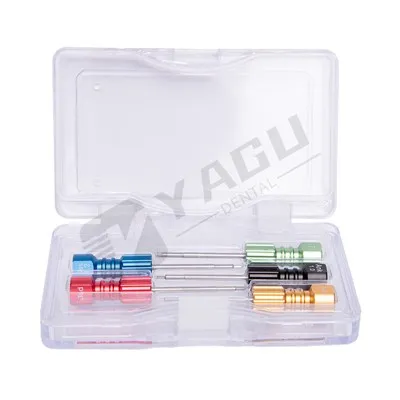
Hey there, dental enthusiasts! I'm here as a supplier of Multi Angled Abutments, and today, we're going to dig deep into how these bad boys stack up against other abutment solutions. So, let's get right into it.
First off, what exactly are abutments? In the dental implant world, an abutment is a crucial component that connects the dental implant (which is placed in the jawbone) to the dental restoration, like a crown or a bridge. It's like the middleman that ensures everything fits together just right.
Let's start with the Straight Abutment. These are the most basic type of abutments out there. They're pretty straightforward, pun intended. Straight abutments are great when the implant is placed perfectly perpendicular to the gum line and the restoration can be easily attached in a straight line. They're simple, cost - effective, and have been around for ages. A lot of dentists still rely on them for routine cases where the implant placement is uncomplicated.
However, straight abutments have their limitations. In real - world scenarios, implant placement isn't always perfect. Sometimes, due to anatomical constraints, like the position of nerves, sinuses, or existing teeth, the implant has to be placed at an angle. And that's where straight abutments fall short. When the implant is angled, using a straight abutment can lead to problems. It can cause improper force distribution on the implant, which may result in loosening of the restoration or even damage to the implant over time. Also, it can be difficult to achieve a natural - looking and functional restoration with a straight abutment when the implant is off - axis.
Now, let's talk about the Multi Angled Abutment. As the name suggests, these abutments are designed to accommodate implants placed at various angles. They offer a high degree of flexibility, which is a game - changer in complex cases. With multi angled abutments, dentists can achieve a more accurate and natural - looking restoration, even when the implant is placed at an angle.


One of the key advantages of multi angled abutments is their ability to optimize force distribution. When the abutment can be adjusted to match the angle of the implant and the restoration, the forces exerted during chewing and biting are more evenly distributed across the implant. This reduces the stress on the implant and the surrounding bone, increasing the long - term stability of the dental restoration.
Another great thing about multi angled abutments is the aesthetic improvement they offer. They allow for better alignment of the restoration with the surrounding teeth, creating a more harmonious and natural smile. This is especially important in the anterior region of the mouth, where appearance matters a great deal.
In addition, multi angled abutments can save time and money in the long run. In cases where a straight abutment would require additional surgical procedures to correct the implant angle or to achieve a proper restoration, multi angled abutments can often be used right away. This means fewer visits to the dentist, less discomfort for the patient, and lower overall costs.
But what about the Straumann Multi Unit Abutment? Straumann is a well - known brand in the dental industry, and their multi - unit abutments are popular for their quality and reliability. These abutments are designed to connect multiple implants, which is useful in cases where multiple teeth need to be replaced.
Straumann multi - unit abutments offer good strength and stability. They are precision - engineered to ensure a secure fit between the implants and the restoration. However, they are more expensive compared to some other abutment options. Also, they may not be as flexible as multi angled abutments when it comes to adjusting to different implant angles. While they can handle some minor angulations, in cases where the implants are placed at significant angles, multi angled abutments are a better choice.
When it comes to the ease of use, multi angled abutments are relatively simple to work with. Dentists can easily adjust the angle of the abutment to match the implant and the restoration requirements. This reduces the complexity of the restoration process and allows for more efficient treatment.
In terms of biocompatibility, most modern multi angled abutments are made from high - quality materials that are well - tolerated by the body. Titanium is a common material used, which has excellent biocompatibility and is resistant to corrosion. This ensures that the abutment doesn't cause any adverse reactions in the patient's mouth and can last for a long time.
Now, let's talk about the market demand. As the demand for more complex and aesthetically pleasing dental restorations increases, the popularity of multi angled abutments is on the rise. Patients are becoming more aware of the options available to them, and they want a solution that not only restores their function but also looks natural. Dentists are also more inclined to use multi angled abutments because they offer a better solution for challenging cases.
In conclusion, multi angled abutments have a lot going for them compared to other abutment solutions. They offer flexibility, better force distribution, improved aesthetics, and ease of use. While straight abutments and Straumann multi - unit abutments have their own places in the dental implant world, multi angled abutments are often the best choice for complex cases.
If you're a dentist or a dental professional looking for a reliable and high - quality multi angled abutment solution, I'd love to talk to you. We have a wide range of multi angled abutments that can meet your specific needs. Whether you're dealing with a simple case with a slight implant angle or a complex multi - implant restoration, our products can help you achieve the best results for your patients.
Don't hesitate to reach out if you're interested in learning more or starting a procurement discussion. We're here to support you every step of the way.
References:
- Dental Implantology Textbooks
- Journal of Dental Research
- Clinical Dentistry Journals