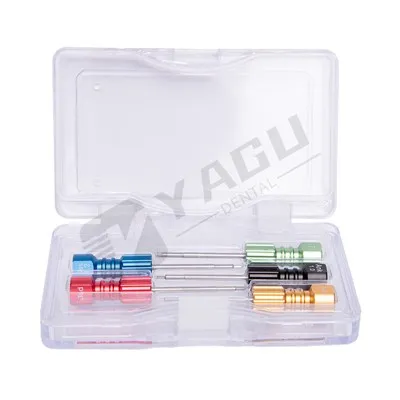
Hey everyone! I'm a supplier of Implant Screw Drivers, and today I wanna talk about a super important topic in the dental field: What is the maximum depth that implant screw drivers can reach?
First off, let's understand what implant screw drivers are. Implant screw drivers are essential tools in dental implant procedures. They're used to insert and tighten the screws that hold dental implants in place. You can check out our range of Implant Screw Drivers on our website.
Now, the maximum depth that these drivers can reach depends on several factors. One of the main factors is the design of the screw driver itself. Different models are made to handle different depths. Some are designed for shallow implants, while others are built for deeper, more complex procedures.
The type of dental implant also plays a huge role. There are various types of implants, each with its own set of requirements. For example, endosteal implants, which are placed into the jawbone, often require screw drivers that can reach greater depths compared to subperiosteal implants, which are placed on top of the bone.
Another factor is the patient's anatomy. Every patient's jawbone is unique. Some patients may have thicker or denser bone, which could affect how deep the screw driver can penetrate. In cases where the bone is more compact, it might be more challenging to reach the desired depth, and special techniques or tools may be needed.


Let's take a closer look at the technology behind these screw drivers. Modern implant screw drivers are often equipped with advanced features to help achieve the right depth. Some have adjustable stops, which allow the dentist to set a specific depth limit. This is really useful as it helps prevent over - insertion of the screw, which could cause damage to the surrounding tissue or bone.
We also have Dental Implant Screwdriver models that come with torque control. Torque is the amount of force applied when turning the screw. By controlling the torque, dentists can ensure that the screw is tightened to the right level without applying too much force, which could lead to complications.
In addition to the screw drivers, other tools in the dental implant toolkit can also influence the maximum depth. For instance, the Bone Chip Maker is used to prepare the bone for the implant. By creating the right environment in the bone, it can sometimes make it easier for the screw driver to reach the required depth.
When it comes to research and development in this area, there's always something new happening. Scientists and engineers are constantly working on improving the design and functionality of implant screw drivers. They're looking for ways to increase the maximum depth that can be reached while also improving the safety and precision of the tools.
In clinical practice, dentists rely on their experience and training to determine the appropriate depth for each patient. They use imaging techniques like X - rays and CT scans to get a clear picture of the patient's jawbone structure before the procedure. This helps them plan the placement of the implant and choose the right screw driver with the appropriate depth capabilities.
But what's the real - world maximum depth that these screw drivers can reach? Well, it can vary quite a bit. In general, for most common dental implant procedures, screw drivers can reach depths ranging from a few millimeters to around 15 - 20 millimeters. However, in more complex cases, with the right tools and techniques, it's possible to reach even greater depths.
It's important to note that while reaching the maximum depth is sometimes necessary, it's not always the goal. The key is to place the implant at the optimal depth for stability and functionality. Over - inserting the screw can cause problems such as nerve damage or damage to the sinus cavity in the upper jaw.
As a supplier, I know how crucial it is to provide high - quality implant screw drivers. We work closely with dental professionals to understand their needs and develop products that meet the highest standards. Our team of experts is always available to offer support and advice on choosing the right tools for different procedures.
If you're a dental professional looking for reliable implant screw drivers, or if you're just interested in learning more about the latest advancements in dental implant technology, I encourage you to reach out. We're here to help you find the best solutions for your patients. Whether you have questions about the maximum depth capabilities of our tools or need assistance with product selection, don't hesitate to get in touch. We're always happy to start a conversation and explore how we can work together to improve dental implant procedures.
References
- Various research papers on dental implant technology and tools
- Clinical guidelines from dental associations
- Manufacturer's product manuals and specifications