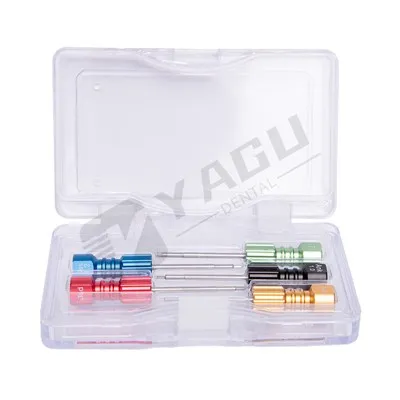
As a leading supplier of dental implant tools, I've witnessed firsthand the transformative power of these precision instruments in modern dentistry. Among these tools, dental implant drills stand out as indispensable assets in the dental implant procedure. In this blog post, I'll delve into the functions of dental implant drills, exploring their crucial role in ensuring successful implant placements.
Creating the Implant Site
The primary function of dental implant drills is to create a precise and well - prepared site for the dental implant. When a patient is missing a tooth, the dentist needs to place an artificial root (the dental implant) into the jawbone. This process begins with the use of a series of drills.
The first step often involves using a pilot drill. This drill is relatively small in diameter and is used to create an initial hole in the jawbone. The pilot drill serves as a guide for subsequent drilling steps. It helps the dentist to accurately position the implant in the correct location and at the appropriate angle. The precision at this stage is of utmost importance because any deviation can lead to improper implant placement, which may result in long - term complications such as implant failure or problems with the patient's bite.
After the pilot drill, a series of larger drills are used to gradually enlarge the hole to the appropriate size for the dental implant. These drills are carefully selected based on the size and type of the implant that will be placed. For example, if a wider implant is required, a set of drills with increasing diameters will be used to ensure a proper fit. The process of enlarging the hole must be done slowly and carefully to avoid over - heating the bone, which can cause damage to the surrounding tissue and reduce the chances of successful osseointegration (the process by which the implant fuses with the bone).
Preparing the Bone
Dental implant drills not only create the physical space for the implant but also prepare the bone to receive it. As the drill penetrates the bone, it creates a roughened surface inside the hole. This roughened surface is beneficial for osseointegration. When the implant is placed in the prepared hole, the rough surface of the bone provides more surface area for the bone cells to attach to the implant. This increased contact area promotes the growth of new bone around the implant, which is essential for the long - term stability of the implant.
In addition, the drilling process can also stimulate the bone's natural healing response. The mechanical stress caused by the drill triggers the release of growth factors and cytokines in the bone tissue. These substances play a crucial role in promoting cell proliferation and differentiation, which are necessary for the formation of new bone.
Ensuring Compatibility
Another important function of dental implant drills is to ensure compatibility between the implant and the bone. Different patients have different bone densities and qualities. For example, some patients may have dense cortical bone, while others may have more porous cancellous bone. Dental implant drills are designed to be used in a variety of bone types.
In cases where the bone is very dense, special drills with stronger cutting edges may be required to penetrate the bone effectively. On the other hand, in patients with softer bone, drills with a more gentle cutting action may be used to avoid over - damage to the bone. By using the appropriate drill for the specific bone type, the dentist can ensure that the implant is placed in a way that maximizes its chances of successful integration with the bone.
Complementary Tools in the Dental Implant Process
While dental implant drills are the core tools in creating the implant site, they work in conjunction with other important dental implant tools. For example, Implant Screw Drivers are used to insert and secure the implant in place. These screw drivers are designed to provide the right amount of torque to ensure that the implant is firmly seated in the prepared hole without causing damage to the implant or the surrounding bone.
Bone Chip Maker is another useful tool in the dental implant procedure. During the drilling process, bone chips are often generated. A bone chip maker can collect these bone chips and prepare them for use in bone grafting procedures. Bone grafting is sometimes necessary to augment the bone in cases where there is insufficient bone volume for proper implant placement. The collected bone chips can be used to fill in the gaps and promote new bone growth.
Dental Implant Screwdriver is also an essential part of the dental implant toolkit. It is used for both the initial placement of the implant and for any subsequent adjustments or maintenance. The screwdriver's design allows for precise control, ensuring that the implant is tightened to the correct specifications.
Quality and Precision in Dental Implant Drills
As a supplier of dental implant tools, I understand the importance of quality and precision in dental implant drills. These drills are made from high - quality materials such as titanium or stainless steel to ensure durability and sharpness. The cutting edges of the drills are precisely engineered to provide efficient and accurate cutting.
In addition, modern dental implant drills are often designed with advanced features such as coolant channels. These channels allow for the continuous flow of coolant during the drilling process. The coolant helps to keep the bone temperature within a safe range, preventing over - heating and reducing the risk of bone damage.
Conclusion
In conclusion, dental implant drills play a multifaceted and crucial role in the dental implant procedure. They are responsible for creating the implant site, preparing the bone, and ensuring compatibility between the implant and the bone. When used in conjunction with other dental implant tools such as Implant Screw Drivers, Bone Chip Maker, and Dental Implant Screwdriver, they contribute to the success of dental implant treatments.


If you are a dental professional looking for high - quality dental implant tools, including top - notch dental implant drills, please feel free to reach out to us for procurement and further discussions. We are committed to providing you with the best products and services to meet your clinical needs.
References
- Misch, C. E. (2018). Contemporary Implant Dentistry. Quintessence Publishing.
- Brånemark, P. I., Zarb, G. A., & Albrektsson, T. (1985). Tissue - Integrated Prostheses: Osseointegration in Clinical Dentistry. Quintessence Publishing.
- Smith, D. M., & Morton, D. (2014). Dental Implant Prosthetics. Wiley - Blackwell.