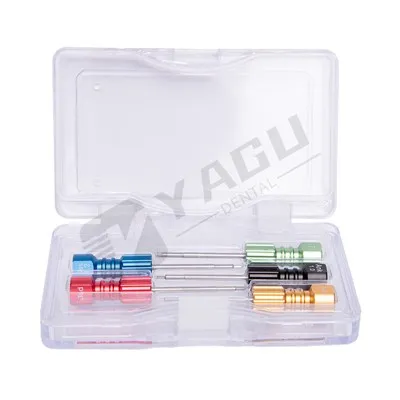
The accuracy of Angled Abutment Straumann installation is a crucial factor in the field of dental implants. As a supplier of Angled Abutment Straumann, I have witnessed firsthand the significance of this precision in achieving optimal treatment outcomes. In this blog, I will delve into the various aspects of the accuracy of Angled Abutment Straumann installation, including its importance, the factors that affect it, and the techniques used to ensure high - level precision.
Importance of Accuracy in Angled Abutment Straumann Installation
Accurate installation of Angled Abutment Straumann is essential for several reasons. Firstly, it directly impacts the functionality of the dental implant. A well - installed angled abutment ensures proper occlusion, which is the way the upper and lower teeth come together when biting or chewing. If the abutment is not installed accurately, it can lead to uneven distribution of forces during mastication, which may cause premature wear of the implant, the restoration, or the natural teeth in the vicinity. This can ultimately result in implant failure or the need for costly and time - consuming repairs.
Secondly, accuracy in installation is vital for the aesthetic outcome of the dental restoration. The angled abutment plays a key role in aligning the artificial tooth or crown with the surrounding natural teeth. A precisely installed abutment allows for a seamless integration of the restoration into the patient's smile, enhancing their overall appearance. On the contrary, an inaccurately placed abutment can lead to a misaligned or awkward - looking restoration, which can have a negative impact on the patient's self - esteem.
Thirdly, proper installation accuracy helps in maintaining the long - term health of the surrounding soft and hard tissues. An accurately placed angled abutment promotes healthy tissue healing and reduces the risk of peri - implant diseases. It allows for proper blood circulation and the formation of a stable biological seal around the implant, which is crucial for preventing bacterial infiltration and subsequent inflammation.
Factors Affecting the Accuracy of Angled Abutment Straumann Installation
Several factors can influence the accuracy of Angled Abutment Straumann installation. One of the primary factors is the quality of the preoperative planning. A detailed and accurate preoperative plan is the foundation for a successful installation. This plan should include a comprehensive assessment of the patient's oral anatomy, including the bone quality, quantity, and the position of the adjacent teeth. Advanced imaging techniques such as cone - beam computed tomography (CBCT) are often used to obtain three - dimensional images of the patient's jaws, which can help in precisely determining the ideal location and angulation for the implant and the abutment.
The skill and experience of the dental professional performing the installation also play a significant role. A well - trained and experienced dentist or oral surgeon is more likely to achieve accurate results. They are familiar with the proper techniques for handling the Angled Abutment Straumann, including how to align it correctly with the implant and how to ensure a secure fit. Additionally, they can make adjustments during the installation process based on their clinical judgment and experience.


The design and quality of the Angled Abutment Straumann itself can affect the installation accuracy. High - quality abutments are manufactured with tight tolerances, which means that they fit more precisely onto the implant. The design of the abutment should also be compatible with the patient's specific oral conditions and the type of restoration planned. For example, some angled abutments are designed for specific implant systems, and using an incompatible abutment can lead to installation difficulties and inaccuracies.
Another factor is the surgical technique used. Minimally invasive surgical techniques are generally preferred as they cause less trauma to the surrounding tissues, which can lead to better healing and more accurate installation. However, the choice of surgical technique depends on various factors such as the patient's bone quality, the location of the implant, and the complexity of the case.
Techniques to Ensure Accuracy in Angled Abutment Straumann Installation
To ensure the accuracy of Angled Abutment Straumann installation, several techniques can be employed. One of the most common techniques is the use of surgical guides. Surgical guides are custom - made devices that are based on the preoperative planning. They are designed to fit precisely onto the patient's jaws and provide a template for the drill and the implant placement. By using a surgical guide, the dental professional can accurately position the implant and the angled abutment according to the planned location and angulation.
Intra - operative imaging can also be used to verify the accuracy of the installation. For example, intra - oral radiographs or CBCT scans can be taken during the surgery to check the position of the implant and the abutment. This allows the dental professional to make immediate adjustments if necessary, ensuring that the final result meets the desired accuracy standards.
The use of torque wrenches is another important technique. Torque wrenches are used to tighten the abutment onto the implant with the correct amount of force. Over - tightening or under - tightening the abutment can lead to problems such as loosening, fracture, or improper seating. By using a torque wrench, the dental professional can ensure that the abutment is tightened to the manufacturer's recommended torque, which helps in achieving a stable and accurate fit.
Comparison with Other Abutment Types
When considering the accuracy of installation, it is also interesting to compare Angled Abutment Straumann with other types of abutments, such as the Hiossen Multi Unit Abutment. Each type of abutment has its own unique features and advantages. The Hiossen Multi Unit Abutment is designed to provide flexibility in connecting multiple implants or in cases where there is a need for a more complex restoration. However, in terms of accuracy, the Angled Abutment Straumann is often preferred in situations where a precise angulation is required to achieve optimal occlusion and aesthetics.
The Angled Abutment Implant in general offers the advantage of being able to compensate for anatomical limitations and achieve a more natural - looking restoration. The Straumann brand is well - known for its high - quality manufacturing and strict quality control, which contributes to the overall accuracy of the installation.
Conclusion
In conclusion, the accuracy of Angled Abutment Straumann installation is of utmost importance in dental implantology. It affects the functionality, aesthetics, and long - term health of the dental restoration. Factors such as preoperative planning, the skill of the dental professional, the quality of the abutment, and the surgical technique all play a role in determining the installation accuracy. By using techniques such as surgical guides, intra - operative imaging, and torque wrenches, dental professionals can achieve high - level precision in the installation.
If you are a dental professional or a dental clinic looking for high - quality Angled Abutment Straumann products, we are here to assist you. Our products are manufactured to the highest standards, ensuring accurate installation and excellent performance. We invite you to contact us for further information and to discuss your procurement needs. We are committed to providing you with the best products and services to meet your clinical requirements.
References
- Misch CE. Dental Implant Prosthetics. Mosby; 2008.
- Tarnow DP, Magner AW, Fletcher P. The effect of the distance from the contact point to the crest of bone on the presence or absence of the interproximal dental papilla. J Periodontol. 1992;63(12):995 - 996.
- Zarb GA, Albrektsson T, Carlsson GE, et al. Textbook of Oral Implantology. Quintessence Publishing; 2010.