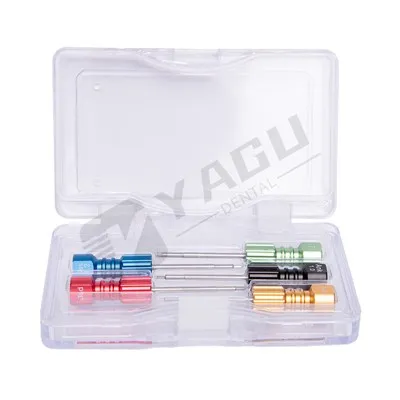
As a seasoned supplier of dental implant tools, I've witnessed firsthand the transformative power of these instruments in modern dentistry. Dental implant procedures have revolutionized the way we treat tooth loss, offering patients a permanent and natural-looking solution. In this blog post, I'll delve into the essential dental implant tools that every dental professional should have in their arsenal.
1. Implant Drills
Implant drills are the workhorses of any dental implant procedure. They are used to create the precise osteotomy (bone hole) in the jawbone where the implant will be placed. The accuracy and quality of the osteotomy are crucial for the long - term success of the implant.
There are different types of implant drills, each with a specific function. Pilot drills are the first to be used, creating a small guide hole in the bone. This helps to ensure the correct position and angulation of the subsequent drills. Twist drills are then used to gradually enlarge the hole to the appropriate diameter for the implant. Countersink drills are used to create a bevel at the entrance of the osteotomy, which helps with the seating of the implant.
High - quality implant drills are made from materials such as titanium or stainless steel, which offer durability and sharpness. They are also designed with specific cutting geometries to minimize heat generation during drilling, which can damage the surrounding bone tissue.
2. Dental Implant Screwdriver
The Dental Implant Screwdriver is a critical tool for the placement and removal of dental implants. It is used to tighten the implant into the osteotomy and to attach the abutment (the connector between the implant and the crown).
A good dental implant screwdriver should have a precise fit with the implant and abutment. This ensures that the correct torque is applied during tightening, which is essential for the stability of the implant. There are different types of screwdrivers, including manual and motor - driven ones. Manual screwdrivers offer more tactile feedback, while motor - driven screwdrivers can provide more consistent torque.
3. Implant Screw Drivers
Implant Screw Drivers are similar to dental implant screwdrivers but are specifically designed for the screws used in dental implant systems. These screws are used to secure various components of the implant, such as the healing abutment or the final restoration.
The design of implant screw drivers is crucial for preventing damage to the screws and the implant components. They are often made with a special tip that matches the shape of the screw head, ensuring a secure grip and accurate torque application. Different implant systems may require different types of implant screw drivers, so it's important to have a comprehensive set.
4. Bone Condensers
Bone condensers are used to compact the bone around the implant site. This helps to increase the density of the bone, which can improve the primary stability of the implant. By condensing the bone, the implant has a better chance of integrating with the surrounding bone tissue, leading to a more successful long - term outcome.
There are different types of bone condensers, including hand - held and motor - driven ones. Hand - held condensers offer more control, while motor - driven condensers can provide more consistent force. They are typically made from materials such as titanium or stainless steel, which are biocompatible and durable.
5. Bone Chip Maker
The Bone Chip Maker is a unique tool that allows dentists to harvest autogenous bone chips during the implant procedure. Autogenous bone is the best material for bone grafting because it is biocompatible and has a high potential for integration with the surrounding bone.
The Bone Chip Maker works by collecting the bone chips generated during the drilling process. These chips can then be used to fill any gaps or defects around the implant site, promoting bone growth and improving the overall success of the implant.
6. Periotomes
Periotomes are used to gently separate the periodontal ligament from the tooth root before extraction. In dental implant procedures, they can also be used to expand the socket and prepare it for implant placement. By using a periotome, the dentist can minimize trauma to the surrounding bone and soft tissue, which can lead to faster healing and better implant success rates.
Periotomes come in different sizes and shapes to accommodate different tooth types and extraction situations. They are typically made from stainless steel or titanium, which are strong and corrosion - resistant.


7. Soft Tissue Management Tools
Soft tissue management is an important aspect of dental implant procedures. Tools such as scalpels, tissue forceps, and suturing materials are used to incise, manipulate, and close the soft tissue around the implant site.
Scalpels are used to make precise incisions in the gingiva (gum tissue). Tissue forceps are used to hold and manipulate the tissue during the procedure. Suturing materials are used to close the incisions after the implant has been placed, promoting proper healing of the soft tissue.
8. Imaging Tools
While not strictly "tools" in the traditional sense, imaging tools such as dental X - rays, CT scans, and intraoral scanners are essential for dental implant planning. Dental X - rays provide a two - dimensional view of the jawbone, allowing the dentist to assess the bone density and the presence of any underlying pathology.
CT scans offer a three - dimensional view of the jawbone, which is crucial for accurate implant placement. They can help the dentist to determine the exact location, angulation, and depth of the implant, as well as to identify any anatomical structures that may be at risk during the procedure.
Intraoral scanners are used to create a digital impression of the patient's teeth and gums. This can be used to design the final restoration, ensuring a perfect fit with the implant and the surrounding teeth.
Conclusion
In conclusion, a comprehensive set of dental implant tools is essential for the success of any dental implant procedure. From the initial planning stages to the final restoration, each tool plays a crucial role in ensuring the accuracy, safety, and long - term success of the implant.
As a supplier of dental implant tools, I understand the importance of providing high - quality, reliable products. Our range of tools is designed to meet the needs of dental professionals at every step of the implant process. Whether you're a seasoned implantologist or just starting out in the field, we have the tools you need to deliver excellent results for your patients.
If you're interested in learning more about our dental implant tools or would like to discuss your specific needs, please don't hesitate to reach out. We're here to support you in providing the best possible care for your patients.
References
- Misch, C. E. (2018). Contemporary Implant Dentistry. Quintessence Publishing.
- Tarnow, D. P., & Elian, N. (2019). Dental Implants: A Clinical Approach. Wiley Blackwell.
- Rangert, B., & Jaffin, R. A. (2017). Osseointegrated Oral Implants: Surgical and Prosthetic Principles. Quintessence Publishing.