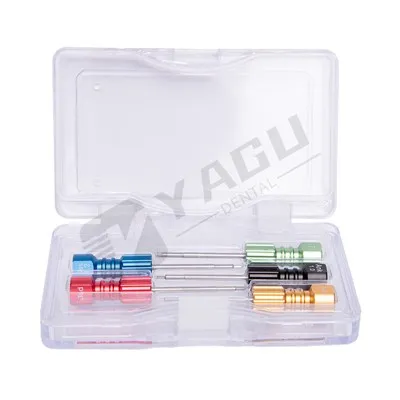
Pre milled abutments are essential components in modern dental implantology, playing a crucial role in the restoration process. The interaction between pre milled abutments and dental cement is a complex yet vital aspect that directly impacts the success and longevity of dental restorations. As a leading supplier of pre milled abutments, I have witnessed firsthand the significance of understanding this interaction. In this blog, I will delve into the science behind how pre milled abutments interact with dental cement, exploring the factors that influence this interaction and the implications for dental professionals.
The Basics of Pre Milled Abutments and Dental Cement
Pre milled abutments are pre - fabricated components designed to connect dental implants to the final restoration, such as a crown or a bridge. They come in a variety of shapes, sizes, and materials, including titanium, zirconia, and composite resins. Dental cement, on the other hand, is used to bond the pre milled abutment to the implant and the final restoration to the abutment. Common types of dental cement include resin - based cements, glass ionomer cements, and zinc phosphate cements.
The interaction between pre milled abutments and dental cement begins at the molecular level. When the cement is applied to the surface of the abutment, it undergoes a series of chemical and physical changes. The cement wets the surface of the abutment, filling in microscopic irregularities and creating a mechanical interlock. Additionally, chemical bonds may form between the cement and the abutment material, further enhancing the bond strength.
Surface Characteristics of Pre Milled Abutments
The surface characteristics of pre milled abutments have a significant impact on their interaction with dental cement. Abutment surfaces can be smooth, rough, or treated with special coatings to improve cement adhesion.
Smooth surfaces, while aesthetically pleasing, may offer limited mechanical interlock for the cement. However, they can be advantageous in terms of cleanliness and reduced plaque accumulation. On the other hand, rough surfaces provide more surface area for the cement to adhere to, increasing the mechanical bond strength. Surface treatments such as sandblasting, acid - etching, or the application of bonding agents can further enhance the surface energy of the abutment, promoting better wetting and adhesion of the cement.
For example, titanium abutments are commonly used due to their biocompatibility and strength. Sandblasting the titanium surface can create a micro - rough texture that improves the mechanical retention of the cement. Zirconia abutments, known for their excellent aesthetics, may require specific surface treatments or the use of resin - based cements with zirconia - specific primers to achieve optimal adhesion.
Chemical Composition of Dental Cement
The chemical composition of dental cement also plays a crucial role in its interaction with pre milled abutments. Different types of cements have different setting mechanisms and bonding properties.
Resin - based cements are popular due to their high bond strength and esthetic properties. They contain monomers that polymerize upon activation, forming a strong bond with both the abutment and the restoration. Resin - based cements can be self - cured, light - cured, or dual - cured. Self - cured cements rely on a chemical reaction between two components to set, while light - cured cements require exposure to a specific wavelength of light. Dual - cured cements combine both mechanisms, offering the advantage of initial light - curing for immediate handling and subsequent self - curing for complete polymerization.
Glass ionomer cements release fluoride, which can help prevent secondary caries. They bond to the tooth structure and some abutment materials through an acid - base reaction. However, their bond strength may be lower compared to resin - based cements, especially on non - tooth surfaces.
Zinc phosphate cements are one of the oldest types of dental cements. They have good compressive strength but relatively low bond strength. They work by a chemical reaction between zinc oxide powder and phosphoric acid liquid.
Environmental Factors
Environmental factors can also influence the interaction between pre milled abutments and dental cement. Temperature, humidity, and the presence of contaminants can all affect the setting and bonding properties of the cement.
Cement setting times are often temperature - dependent. Higher temperatures can accelerate the setting reaction, while lower temperatures can slow it down. This is important to consider during the clinical procedure, as improper setting times can lead to incomplete polymerization and reduced bond strength.
Humidity can also have an impact, especially on resin - based cements. Excessive moisture in the oral environment or during the cementation process can interfere with the polymerization reaction, leading to a weaker bond. Contaminants such as saliva, blood, or debris on the abutment surface can also prevent proper adhesion of the cement. Therefore, it is essential to thoroughly clean and dry the abutment surface before cementation.
Clinical Implications
Understanding the interaction between pre milled abutments and dental cement has several clinical implications. A strong bond between the abutment and the cement is essential for the long - term success of the dental restoration. A weak bond can lead to cement dissolution, microleakage, and ultimately, restoration failure.
Dental professionals need to carefully select the appropriate pre milled abutment and dental cement based on the specific clinical situation. Factors such as the type of implant, the location of the restoration, and the patient's oral hygiene should all be considered. For example, in areas with high occlusal forces, a stronger - bonding cement and a more durable abutment material may be required.
Proper technique during the cementation process is also crucial. This includes ensuring proper cleaning and preparation of the abutment surface, accurate mixing of the cement, and appropriate application and seating of the restoration. Any deviation from the recommended technique can compromise the bond strength and the overall success of the restoration.


Product Recommendations
As a pre milled abutment supplier, I can recommend some of our high - quality products that interact well with different types of dental cements. The Nobel Temporary Abutment is a great option for temporary restorations. It is made of high - quality materials and has a surface finish that promotes good cement adhesion.
The Osstem Multi Unit 3D Analog is suitable for complex implant restorations. Its unique design allows for precise cementation and a strong bond with the dental cement.
Our Castable Implant Abutment offers excellent customization options. It can be cast to fit the specific requirements of the restoration and has a surface that can be treated to enhance cement adhesion.
Contact for Procurement
If you are a dental professional or a dental laboratory interested in purchasing high - quality pre milled abutments, we are here to serve you. Our products are designed to provide optimal interaction with dental cement, ensuring the success of your dental restorations. Contact us to discuss your specific needs and start a procurement negotiation. We look forward to working with you to achieve the best results in dental implantology.
References
- Ferracane JL. Resin composites - state of the art. Dent Mater. 2011;27(2):29 - 38.
- Watts DC, Cash AJ. Dental materials: properties and manipulation. Elsevier Health Sciences; 2012.
- Van Meerbeek B, De Munck J, Yoshida Y, Inoue S, Peumans M. Adhesion to enamel and dentin: current status and future challenges. Oper Dent. 2003;28(3):215 - 235.