Are there any new technologies for manufacturing straight abutments?
In the dynamic landscape of dental implantology, straight abutments are fundamental components that bridge the gap between dental implants and prosthetic restorations. As a dedicated straight abutment supplier, I am constantly attuned to the latest advancements in manufacturing technologies that can enhance the quality, precision, and functionality of these crucial dental elements. In this blog, we will explore the new technologies revolutionizing the production of straight abutments.
Computer - Aided Design and Manufacturing (CAD/CAM)
CAD/CAM technology has been a game - changer in the dental manufacturing industry, and straight abutments are no exception. With CAD, dental professionals can create highly accurate 3D digital models of straight abutments. This allows for precise customization based on the patient's specific anatomical features, such as the implant position, angulation, and the requirements of the final restoration.
The design process in CAD is highly flexible. Designers can easily modify the shape, size, and surface characteristics of the straight abutment to achieve the best fit and esthetics. Once the design is finalized, the CAM system takes over. CAM uses computer - controlled milling machines to fabricate the straight abutment from a solid block of material, such as titanium or zirconia.
The advantages of CAD/CAM for manufacturing straight abutments are numerous. Firstly, it offers unparalleled precision. The milling process can achieve tolerances in the micrometer range, ensuring a perfect fit between the abutment and the implant. Secondly, it reduces the production time significantly compared to traditional manufacturing methods. Instead of days of manual labor, a straight abutment can be milled in a matter of hours. Thirdly, CAD/CAM allows for consistent quality control. Each abutment produced is an exact replica of the digital model, minimizing the variability that can occur with manual fabrication.
Additive Manufacturing (3D Printing)
Additive manufacturing, commonly known as 3D printing, is another emerging technology in the production of straight abutments. Unlike subtractive manufacturing methods like milling, 3D printing builds the abutment layer by layer from a digital model.
There are different types of 3D printing technologies applicable to dental straight abutments. For example, powder - bed fusion techniques can be used to print titanium straight abutments. In this process, a laser or an electron beam selectively fuses metal powder particles together, layer by layer, to form the desired shape.
One of the main benefits of 3D printing for straight abutments is its ability to create complex geometries that would be difficult or impossible to achieve with traditional methods. For instance, internal structures such as porous surfaces can be incorporated into the abutment design. These porous surfaces can promote osseointegration and improve the long - term stability of the implant - abutment complex.
Moreover, 3D printing is a more cost - effective option for small - batch production. It eliminates the need for expensive custom - made molds and reduces material waste. Manufacturers can print only the exact amount of abutments required, which is especially beneficial for prototype development and personalized dental solutions.
Surface Modification Technologies
Surface modification of straight abutments is a crucial aspect of their manufacturing process, and new technologies are continuously emerging in this area. One of the significant advancements is the use of nanostructured coatings. These coatings can be applied to the surface of the abutment to enhance its biocompatibility, corrosion resistance, and antibacterial properties.
Nanocoatings can be made of various materials, such as titanium dioxide, hydroxyapatite, or other bioactive substances. Titanium dioxide coatings, for example, have photocatalytic properties that can help in reducing the adhesion of bacteria on the abutment surface. Hydroxyapatite coatings mimic the natural bone mineral composition, promoting better integration of the abutment with the surrounding bone tissue.
Another surface modification technique is sandblasting and acid - etching. These processes can create a micro - rough surface on the straight abutment, which also improves osseointegration. The micro - roughness provides a larger surface area for cell adhesion and can stimulate the growth of bone - forming cells. Manufacturers are now able to precisely control the degree and pattern of surface roughness, optimizing the biological response of the abutment.
Quality Control and Inspection Technologies
In addition to the manufacturing technologies themselves, the methods for quality control and inspection of straight abutments have also seen significant improvements. Optical coherence tomography (OCT) is a non - invasive imaging technique that can be used to visualize the internal and external structure of the abutment with high resolution. It can detect any internal defects, such as porosity or cracks, that may not be visible to the naked eye.
Coordinate measuring machines (CMMs) are also widely used for dimensional inspection of straight abutments. These machines can accurately measure the size, shape, and position of the abutment features, ensuring that they meet the design specifications. Advanced software can analyze the measurement data and provide detailed reports on the quality of the manufactured abutments.
Comparison with Other Abutment Types and Related Products
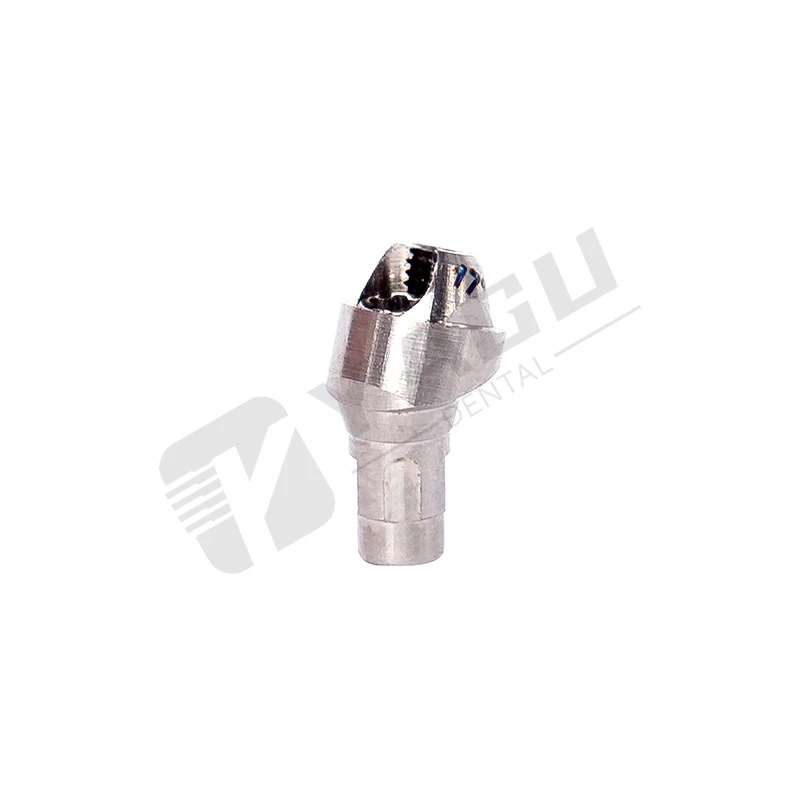
While straight abutments have their unique advantages, it's important to mention other types of abutments that are also available in the market. You can explore Angled Abutment Implant for situations where the implant has an angled position. Angled abutments can correct the orientation of the restoration and are useful in cases where the implant placement is not ideal.
Multi Unit Abutment is another option, which is designed to connect multiple implants together. This type of abutment is often used in fixed dental prostheses and can provide better stability and load - distribution.
For those interested in high - quality angled abutments from a well - known brand, Angled Abutment Straumann offers reliable solutions with excellent precision and biocompatibility.

Conclusion
The manufacturing of straight abutments is undergoing a rapid transformation thanks to new technologies. CAD/CAM and 3D printing are enabling more precise, customized, and efficient production, while surface modification and quality control technologies are enhancing the performance and safety of these dental components. As a straight abutment supplier, we are committed to leveraging these new technologies to offer our customers the highest - quality products.
If you are in the market for straight abutments or have any questions about our products, we invite you to reach out for a procurement discussion. We are eager to collaborate with you and provide solutions that meet your specific needs.
References
- Darveau, R. P. (2010). Periodontal diseases: pathophysiology. Journal of Dental Research, 89(3), 193 - 207.
- Nevins, M., Meijndert, H. C., Schütz, M., Everts, V., & Cochran, D. L. (2018). Osseointegration: scientific background. Periodontology 2000, 76(1), 21 - 41.
- Özcan, M., & Vallittu, P. K. (2015). CAD/CAM technology in prosthodontics. Journal of Prosthetic Dentistry, 113(2), 129 - 134.