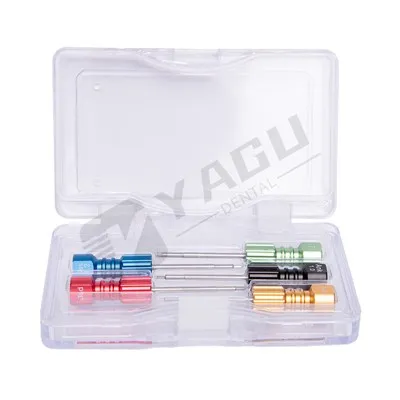
Are there any international standards for temporary abutments? That's a question I often get asked as a supplier of Temporary Abutment. In the dental implant world, temporary abutments play a crucial role. They're used during the transition period between implant placement and the final restoration. But when it comes to international standards, it's a bit of a mixed bag.


First off, let's talk about what temporary abutments are. These are basically short - term connectors that attach to the dental implant in the jawbone. They help in creating a proper fit for the future permanent restoration, like a crown or a bridge. They also assist in soft tissue management around the implant site.
Now, the big question: Are there set international standards? Well, there isn't a one - size - fits - all answer. There are some general guidelines and regulations in different parts of the world, but they vary.
In Europe, the European Union has strict regulations under the Medical Device Regulation (MDR). Dental implants and their components, including temporary abutments, are considered medical devices. The MDR sets out requirements for safety, performance, and quality management. Manufacturers need to prove that their products meet these standards through rigorous testing and documentation. This means that if you're a supplier like me, selling temporary abutments in the EU, you've got to make sure your products comply with these rules.
Over in the United States, the Food and Drug Administration (FDA) is in charge of regulating medical devices. Temporary abutments fall under their jurisdiction. The FDA has a classification system for medical devices, and depending on the risk level associated with the product, different levels of scrutiny are applied. For temporary abutments, they usually require pre - market notification or approval, which involves providing data on the device's safety and effectiveness.
In Asia, different countries have their own regulatory frameworks. For example, Japan has its own set of regulations for medical devices, and South Korea also has strict rules in place. These regulations often focus on ensuring the safety of patients and the quality of the products.
But here's the thing. Even with these regulations, there isn't a single, unified international standard for the design, material, or performance of temporary abutments. Different manufacturers might have their own proprietary designs and materials. Some use titanium, which is a popular choice because of its biocompatibility. Titanium can integrate well with the body's tissues and is strong enough to withstand the forces during the temporary restoration period.
There are also other materials like Dentium Peek Scanbody. PEEK (polyetheretherketone) is a polymer that's becoming more common in dental applications. It's lightweight, has good mechanical properties, and is radiolucent, which can be an advantage during imaging procedures.
When it comes to the design of temporary abutments, there are a few key factors. The connection between the abutment and the implant is crucial. It needs to be stable and reliable to prevent any movement or loosening. Different implant systems have their own unique connection designs, and the temporary abutments need to be compatible with these systems. For example, the Straumann Ti Base has a specific connection mechanism, and any temporary abutment used with it must fit properly.
The height and shape of the temporary abutment also matter. They need to be tailored to the patient's specific oral anatomy and the requirements of the final restoration. A well - designed temporary abutment can help in creating a natural - looking and functional final restoration.
Another aspect is the surface finish of the temporary abutment. A smooth surface can reduce the accumulation of plaque and bacteria, which is important for maintaining good oral hygiene. Some manufacturers use special surface treatments to achieve this.
So, while there aren't unified international standards, the regulatory bodies around the world are working towards ensuring that temporary abutments are safe and effective. As a supplier, I'm constantly keeping an eye on these regulations and making sure that our products meet the highest quality standards.
We're also in touch with dental professionals to understand their needs and feedback. They're on the front - line, using these products in their daily practice, and their insights are invaluable. For example, they might tell us about issues with fit, or they might suggest improvements in the design based on their patient experiences.
In the end, whether you're a dentist looking for a reliable temporary abutment for your patient or a distributor interested in stocking our products, it's important to choose a supplier who understands the regulations and is committed to quality.
If you're in the market for high - quality temporary abutments, I'd love to have a chat with you. We can discuss your specific requirements and see how our products can fit into your practice or business. Don't hesitate to reach out for more information and to start a procurement discussion.
References
- European Union Medical Device Regulation (MDR)
- United States Food and Drug Administration (FDA) regulations on medical devices
- Regulatory frameworks of Asian countries such as Japan and South Korea